

Most of an old car can live a second life. The steel in its frame can be melted into new steel, the copper in its wiring can become new cable, and the lead in its battery can go straight into a new battery. If you have never sold a car for scrap, though, it is hard to know which parts actually get recycled, who does the work, and how much ends up in a landfill.
This guide lists the common recyclable car parts, what each one is made of, and what it turns into. It matters more than most people think: about 85% of a vehicle’s weight can be recycled or reused, according to the Automotive Recyclers of Canada. You will also see exactly what happens to every part after you sell your car to Alberta Car Buyers, and who handles each step along the way.
We buy whole vehicles. We do not sell parts. Alberta Car Buyers is a licensed Calgary auto wrecker that pays cash for vehicles in any condition and delivers every car to a licensed Alberta recycler. We do not run a salvage yard, so the recycling work in this guide happens at the recycler.
Which Recyclable Car Parts Get Recovered Most Often?
The car parts recycled most often are the steel body and frame, aluminum wheels, the engine block, the transmission, the catalytic converter, the battery, the radiator, the copper wiring, the starter and alternator, the exhaust system and the tires. Metal is the reason. Steel, aluminum, copper and lead are worth recovering, so recyclers build their whole process around them.
| Car part | Main material | What it becomes |
|---|---|---|
| Body panels and frame | Steel | Shredded and melted into new steel |
| Wheels and some body panels | Aluminum | Remelted into new aluminum parts and products |
| Engine block | Cast iron or aluminum | Drained, then melted down for new metal |
| Transmission | Steel and aluminum | Rebuilt for reuse when it still works, otherwise melted down |
| Catalytic converter | Steel shell with platinum, palladium and rhodium inside | Precious metals refined and used again |
| Battery | Lead, plastic and acid | Lead recovered for new batteries |
| Radiator | Aluminum or copper | Metals separated and remelted |
| Wiring harness | Copper with a plastic coating | Copper stripped out for new electrical products |
| Starter and alternator | Steel, aluminum and copper | Rebuilt for reuse or separated into metals |
| Exhaust pipes and muffler | Steel | Shredded with the body and recovered as steel |
| Tires | Rubber with steel belts | Shredded for fuel or made into products like road surfacing |

The catalytic converter holds the most valuable metals
Platinum, palladium and rhodium are what make a catalytic converter worth so much to recyclers. Refiners crush the ceramic core into a powder, test how much of each metal it holds, and recover those metals for reuse, as PMR explains in its catalytic converter guide. This is also why a car with a stolen converter gets a lower offer.
Car batteries are recycled at a rate close to 100%
Lead-acid car batteries are one of the most recycled products in the world, with recycling rates of nearly 100% in Canada, the United States and Mexico, according to the Commission for Environmental Cooperation. The recovered lead goes back to battery makers.
Tires go through their own Alberta stewardship program instead of the metal stream. More on that in the maintenance section below.
What Happens to Your Car's Parts After You Sell It to Alberta Car Buyers?
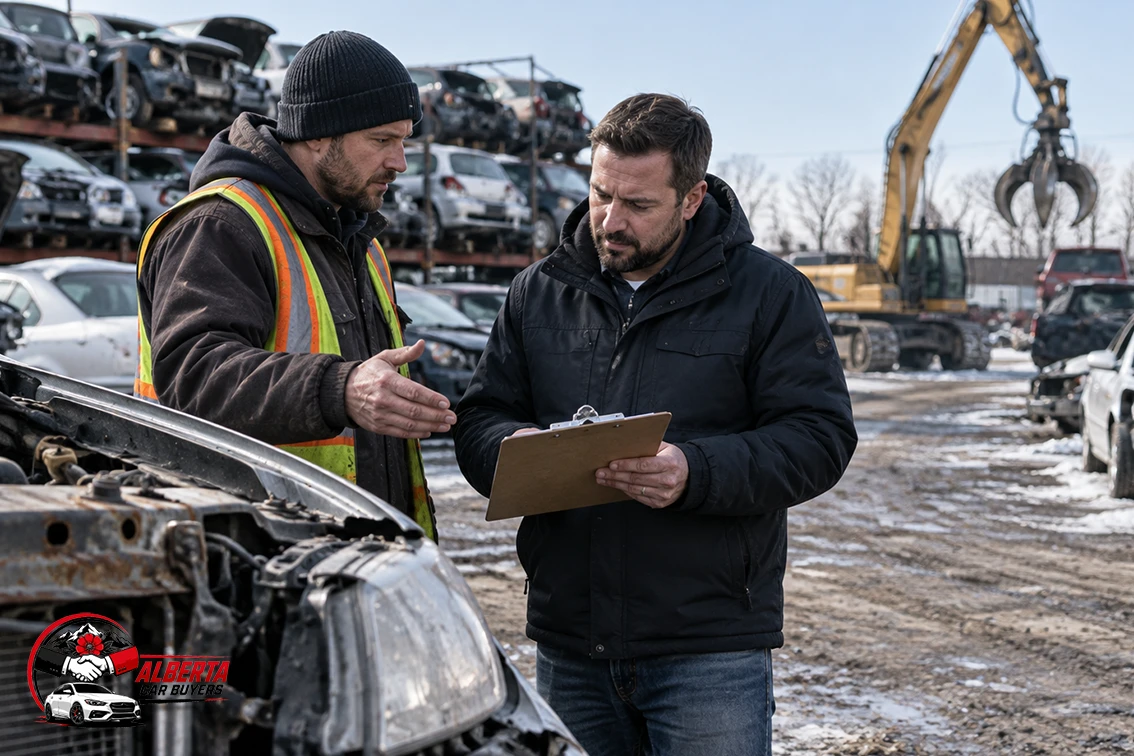
Your car goes from your driveway to a licensed Alberta recycler in one trip, and Alberta Car Buyers handles everything up to that hand-off. Here is the full path, step by step:
- You get a cash offer. Call or use the online form. Offers run from $200 to $20,000, depending on the year, make, model, condition and weight. Our guide to scrap car prices in Alberta shows what moves the number.
- We tow it and pay you. Towing is free. You sign the Alberta bill of sale and get paid at pickup.
- We deliver the whole vehicle to a licensed recycler. Nothing is pulled off the car first, and we keep no parts to resell.
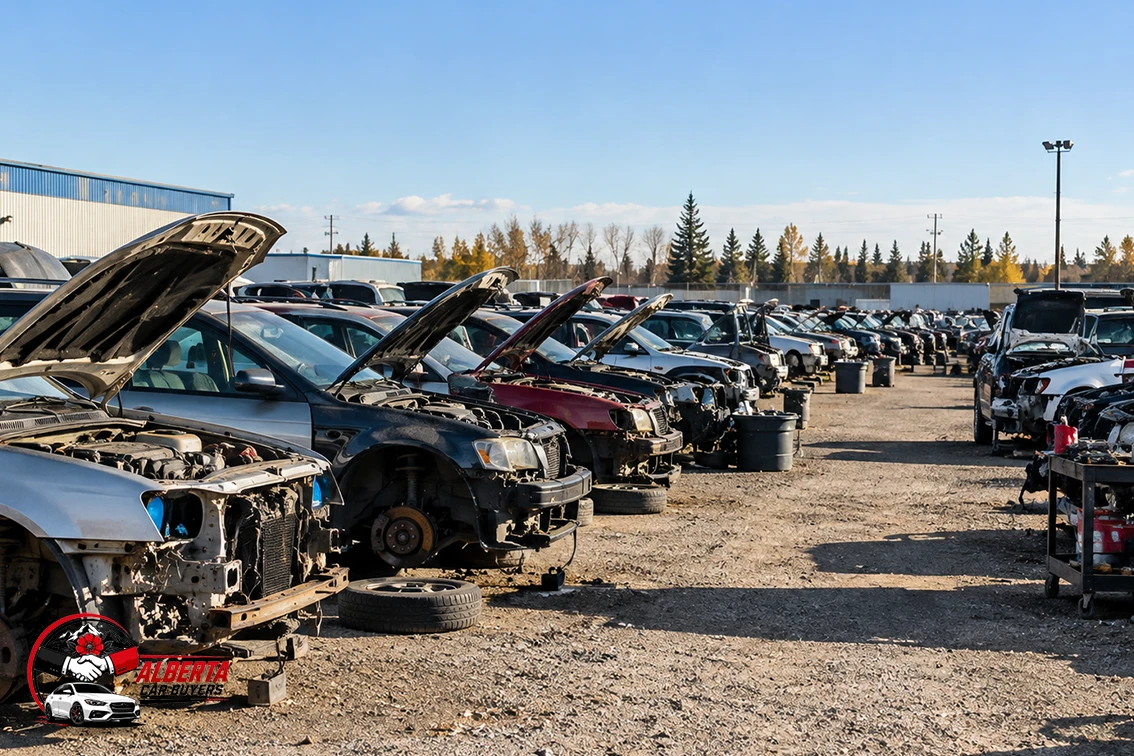
- The recycler drains and makes it safe. Fuel, oil, coolant, the battery, the tires and the airbags come out first. Mercury switches in pre-2004 vehicles are removed too. A typical car holds 40 to 50 litres of fluids, according to the Automotive Recyclers of Canada.
- The recycler recovers what can be reused. Working parts may be cleaned, tested and resold by the recycler, and the catalytic converter goes to a refiner.
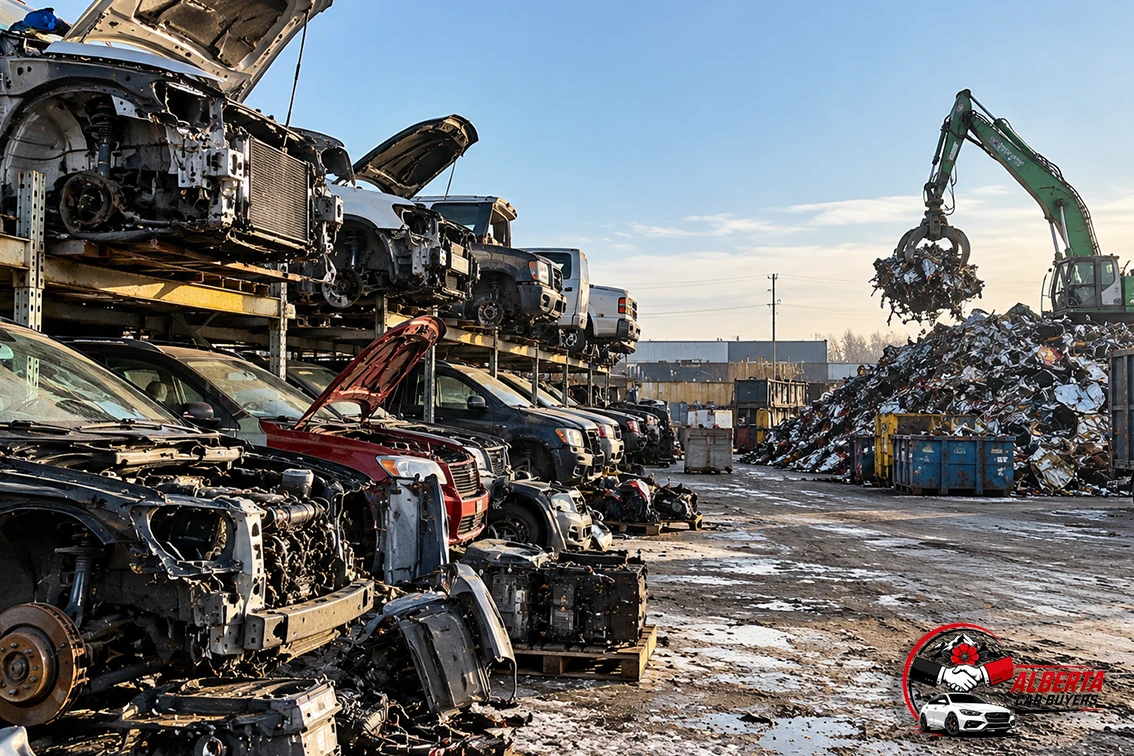
- The shell is crushed and shredded. Magnets and other equipment separate steel from aluminum, copper and the leftover “fluff” of plastic, foam and glass.
Our role ends at step 3. To see the seller’s side in more detail, read about the process of scrapping a car in Calgary.

How Much of a Car Can Actually Be Recycled?
About 85% of a vehicle’s weight can be recycled or reused, according to Steve Fletcher of the Automotive Recyclers of Canada, quoted in CAA Magazine. The other 15% is mostly plastic, glass and foam, and it usually goes to landfill because separating so many types of plastic is not yet worth the cost.
The scale is big. An estimated 1.6 million vehicles come off Canadian roads every year, so the way each one is handled at the end of its life adds up fast. Selling to a buyer that sends cars to licensed recyclers keeps the metal in use and the fluids out of the ground.
Which Recyclable Materials Come Off a Car During Maintenance and Repair?
Engine oil, oil filters, coolant, batteries and tires are the recyclable materials removed most often during regular maintenance and repair. You do not have to scrap a car to recycle them. In Alberta, each one has a clear drop-off route:
- Used oil, oil filters and oil containers: collected through Alberta Recycling’s used oil materials recycling program, which also added antifreeze, diesel exhaust fluid and windshield washer fluid on October 1, 2026.
- Tires: covered by Alberta’s tire stewardship program. In Calgary, City Eco Centres take up to 12 tires a day at no cost.
- Batteries: ask the shop that installs your new battery to take the old one, or bring it to a battery recycler.
- Brake rotors, drums and other worn metal parts: accepted as scrap metal.
When the whole car is done, you do not need to remove any of these yourself. Leave the fluids, battery and tires in place. The recycler removes them safely after we deliver the car.
Does a Missing Part Change What Your Car Is Worth?
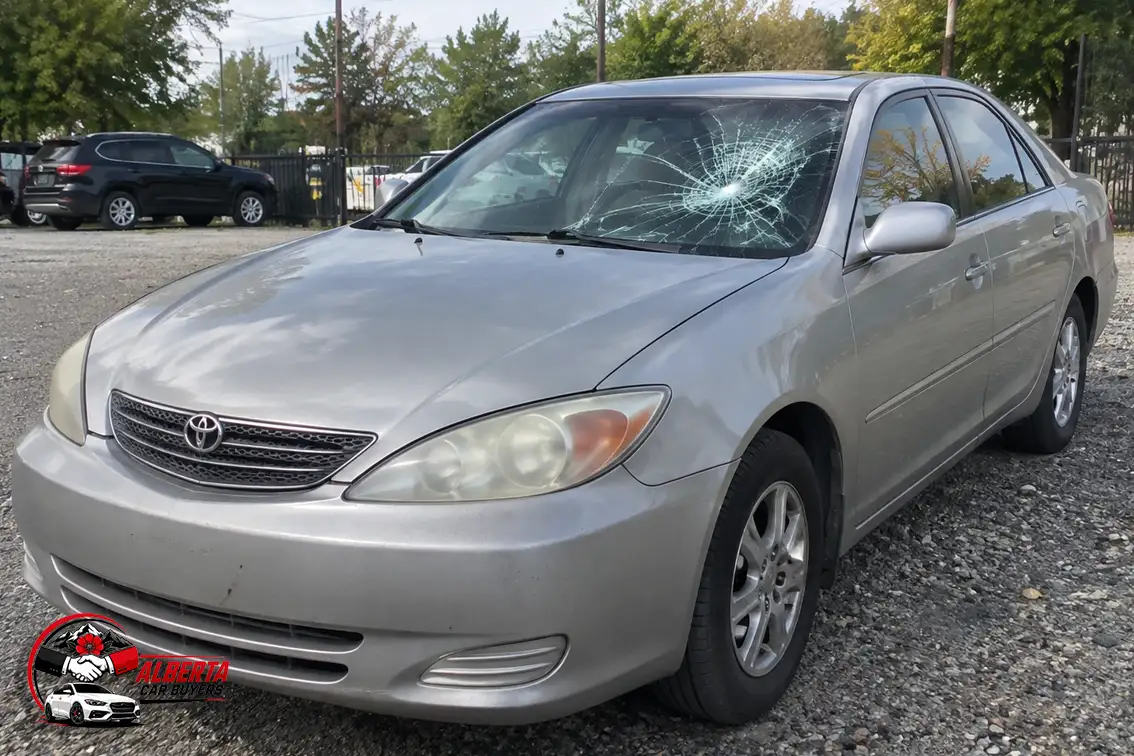
Yes, a missing part lowers the offer, but it does not stop the sale. The recycler gets less from a car with no catalytic converter, engine or transmission, so the price reflects that. Here is how it usually plays out:
Lowers your offer
- Stolen or removed catalytic converter
- Missing engine or transmission
- Missing aluminum wheels
Usually does not matter
- Dead battery
- Flat or missing tires
- A car that will not start
Alberta Car Buyers still buys incomplete vehicles. Read more on how to scrap a car with parts missing in Alberta, or see a few simple ways to maximize the value of your scrap car before you call. If a failed transmission is the reason you are selling, compare the numbers first: is it worth fixing a transmission?

Mobile Auto Wrecker, Salvage Yard or Recycler: Who Does What?
Each one handles a different stage of a car’s end of life, and Alberta Car Buyers only handles the buying, pickup and delivery stage. This table shows where each fits:
| Who | What they do | Sell parts? | Do you visit a yard? |
|---|---|---|---|
| Alberta Car Buyers (mobile auto wrecker) | Buys whole vehicles, tows them for free, pays at pickup and handles the paperwork | No | No, we come to you |
| Salvage yard | Takes cars apart, stores them and sells used parts | Yes | Usually |
| Licensed recycler and shredder | Drains fluids, removes hazardous parts, shreds the shell and sells the metal | Some do | Rarely, as a seller |
For a closer side-by-side, see Alberta Car Buyers vs salvage yards. If your car has a branded title, this breakdown of scrap car vs salvage car explains how the title affects the sale.
Ready to Sell Your Car for Recycling in Alberta?
We pay $200 to $20,000 for vehicles in any condition, including a car that won’t start, with free towing across Calgary and 55+ Alberta communities. Call 8 AM to 11 PM, every day, and get paid at pickup.
Call (587) 324-2142Get a Free Cash OfferCommon Questions About Recyclable Car Parts
What parts of a car can be recycled?
Almost every metal part of a car can be recycled, including the steel body and frame, aluminum wheels, engine block, transmission, radiator, copper wiring, exhaust system and catalytic converter. Batteries, tires, oil and coolant are recycled through their own programs. Plastics, glass and foam are the hardest to recycle and often end up in landfill.
What recyclable materials are commonly removed during vehicle maintenance and repair?
Engine oil, oil filters, coolant, batteries and tires are the most common. Worn brake rotors and drums are recyclable scrap metal too. In Alberta, used oil, filters and containers go through Alberta Recycling’s used oil materials program, and antifreeze was added to that program on October 1, 2026.
Which car components can be reconditioned for reuse?
Engines, transmissions, starters, alternators and undamaged body panels are the components most often cleaned, tested and resold for reuse. That work happens at licensed recyclers and parts sellers. Alberta Car Buyers does not recondition or sell parts. It delivers whole vehicles to licensed recyclers.
What materials are recovered from recycled car parts?
Steel, aluminum, copper, lead and the precious metals platinum, palladium and rhodium are the main materials recovered. About 85% of a vehicle’s weight can be recycled or reused, according to the Automotive Recyclers of Canada.
Sources
- Automotive Recyclers of Canada, quoted in CAA Magazine: Where do old cars go? (2022)
- Automotive Recyclers of Canada: Auto wreckers scrap the old ways
- Alberta Recycling Management Authority: Used Oil Materials Recycling Program
- City of Calgary: Tire recycling
- Commission for Environmental Cooperation: Guidelines on recycling spent lead-acid batteries (2016)
- PMR: Catalytic converter 101