
Anyone selling an unwanted vehicle wants the same thing: a fair price from a legitimate buyer, paid in full, with no unpleasant surprises at pickup. Most transactions go that way, but scams do happen around junk-car sales, auto recyclers, cash-for-cars offers, and online vehicle listings. They can involve the buyer, the payment, a link, a fee, or someone pretending to be a business. The good news is that a few practical checks reduce the risk considerably, and none of them requires technical knowledge. This guide explains the common junkyard scams and how junkyard scams in Alberta tend to look, the warning signs that go with each one, and the steps that help sellers verify a buyer, confirm payment, and respond if something goes wrong.
Want a Straightforward, Scam-Free Car Sale?
If you want to know exactly what your vehicle is worth under current Alberta market conditions, Alberta Car Buyers can give you a firm number quickly. We buy vehicles in any condition across Calgary and 55+ Alberta cities, with free towing and cash paid on pickup. Email hello@albertacarbuyers.ca or get a quote and we’ll get back to you with a real offer, no obligation.

What Are Common Junkyard Scams in Alberta?
Common junkyard scams are fraud patterns that target people selling a vehicle, usually through fake payments, fake links, impersonation, or surprise charges. The patterns below are documented across Canada by the Canadian Anti-Fraud Centre and aren’t unique to Alberta, and no single one can be ranked as the most common here. A warning sign isn’t proof of fraud, but it’s a reason to slow down and verify independently.
| Scam pattern | Warning sign | Prevention step |
|---|---|---|
| Fake e-transfer or payment confirmation | A message, screenshot, or email says payment is pending or sent and pushes you to act before funds appear | Check your own banking app, and release nothing until the funds are in your account |
| Overpayment, refund request, or fake cheque or draft | The buyer sends more than agreed, or a cheque or draft arrives, and you're asked to return the difference | Don't send money back, and have your financial institution verify the payment first |
| Fake VIN or vehicle-history report link | A buyer insists you buy a report from a specific website | Don't pay through a buyer's link, and choose a reputable provider yourself |
| Phishing and impersonation | A message asks you to click a link, scan a QR code, or share a security code, or a business's details don't match | Never share security codes, and find the business's contact details yourself |
| Unexpected fees, deposits, or middleman charges | You're asked to pay a fee, deposit, shipper, or "buyer-finding" charge before you're paid | Decline requests to pay first, and get any legitimate fee in writing |
| Quote switching or pressure to release the vehicle | The price changes at pickup, or you're urged to hand over keys or papers before payment is verified | Compare with your written quote, and verify payment before releasing anything |
Three habits sit underneath every row. Scams succeed on urgency, on payment confusion, and on messages that look official. Independent verification counters all three, which means finding a business’s contact details yourself, checking payment in your own account, and confirming terms in writing.
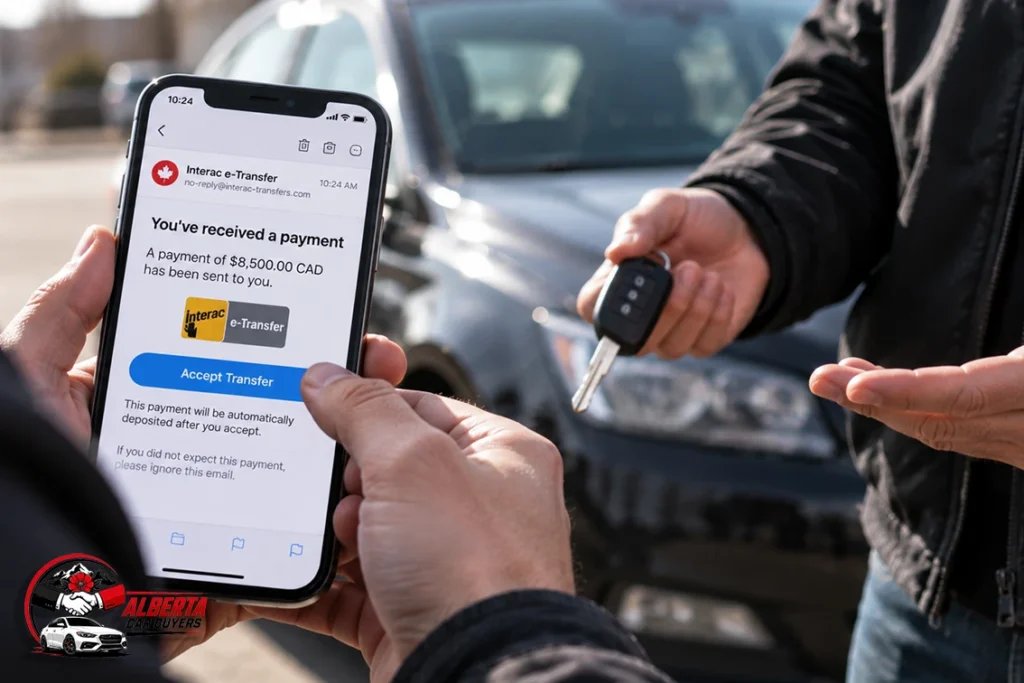
How Do Fake E-Transfer and Payment Confirmation Scams Work?
A payment notification, email, text, or screenshot isn’t proof that money has arrived. In a fake payment scam, the seller receives a message that looks like an e-transfer notice or says a payment is pending, and it pushes the seller to act before the funds exist. The Canadian Anti-Fraud Centre describes this as a spoofed payment: a message claims a payment is pending, the seller releases the item, and only then discovers that no payment exists.
Two variations deserve attention. In one, the message asks for something before releasing the money, such as a tracking number or a fee to unlock the payment. In another, a fake e-transfer email or text asks you to click a link and accept the transfer, and the link leads to a page designed to capture your banking credentials. A related tactic sends a QR code and says you must scan it to receive a payment, when scanning it can expose your online-banking information.
To verify payment safely:
- Open your banking app or type your bank’s address yourself, and don’t use a link from a message.
- Look for the deposit in your account, not only in an email.
- Never share a security code or multi-factor authentication code with anyone.
- Don’t release the vehicle, keys, or documents until the funds are confirmed.
If the payment can’t be verified, pause the transaction. A legitimate buyer will understand a short delay, and pressure to hurry is a warning sign.
What Is an Overpayment Scam When Selling a Junk Car?
An overpayment scam is a scheme where a buyer sends, or appears to send, more than the agreed price and asks the seller to return the difference. The Canadian Anti-Fraud Centre explains that fraudsters use compromised bank accounts, fraudulent cheques, and stolen credit cards for this, and ask the seller to deposit the funds and send the excess straight back. Because the original payment isn’t genuine, the seller can lose both the vehicle and the money returned.
Why you shouldn’t send back the difference. Any money you return is real, while the payment you received may not be. A check or bank draft can show as available in your account before your financial institution has fully verified it, so an available balance isn’t proof that the payment is genuine.
What to do if a buyer says they overpaid. Don’t send anything back. Tell the buyer you’ll confirm the payment with your financial institution first, and ask for any correction to come from them. If the story keeps changing or the pressure increases, treat that as a warning sign and consider ending the transaction.
What Is a Fake VIN Report Scam?
In a fake VIN report scam, a supposed buyer asks the seller to purchase a vehicle-history report from a specific website, and the site collects payment information instead of providing a real report. The Canadian Anti-Fraud Centre warns that when a vehicle is for sale online, fraudsters may ask for a “VIN report” showing its accident history and send a link to a website that asks for credit card information to access it.
The risk lies in the link. A buyer-supplied website can capture your card number and personal details, and the fake report may never arrive. If a buyer wants a report, you can decline to pay through their link, choose a reputable provider yourself, or let the buyer purchase their own. A buyer who insists on one particular website is showing a warning sign, though not proof of fraud.
Sharing the VIN itself is a separate matter. A buyer needs the vehicle’s details to give a quote, and the VIN is displayed on the vehicle, so providing it to a verified business is normal. What deserves caution is the request to pay for something through a link you didn’t choose.
How Do Phishing and Impersonation Scams Work?
Phishing and impersonation scams rely on messages that appear to come from a legitimate business, payment service, or organization. Scammers can copy names, logos, and email styles, and they can build websites that look professional. Alberta’s consumer alerts remind people that personal and business information can be used in identity theft and fraud, and they advise researching a business and verifying its legitimacy before disclosing information.
Common phishing warning signs include:
- an email address or website that’s slightly different from the real business’s
- urgent wording that pushes you to click, pay, or respond immediately
- a link, attachment, or QR code you didn’t expect
- a request for a password, security code, or full banking details
- contact details that don’t match what you find independently
To verify who you’re dealing with, find the business’s official website and phone number through your own search, then compare them with what the message gave you. Call the number you found yourself, not the one in the message. A professional-looking website, logo, or review page doesn’t prove legitimacy.
Unexpected Fees, Deposits, and Quote Changes: When Are They a Red Flag?
An unexpected request for money before pickup, processing, towing, release, or payment deserves scrutiny. A fee that’s clearly disclosed in writing before you agree is different from a surprise charge introduced after you’ve committed. Fraudsters sometimes ask the seller to pay first so that a payment can be released, and the Canadian Anti-Fraud Centre advises never transferring funds in order to receive a payment for an item you’re selling. A related resale scam involves someone claiming to have a buyer and asking for a fee, after which the buyer never appears.
If a buyer changes the agreed price at pickup, pause before handing over the vehicle or keys. Ask for the specific reason, compare the new number with your written quote, and decline if the change isn’t explained. A price difference can be an honest correction or a pricing disagreement, so don’t assume fraud, but don’t feel pressured to accept either. If you’re unsure whether an offer was reasonable in the first place, you can learn what affects scrap-car value.
Before pickup, confirm these in writing:
- the agreed price
- any fees, and who pays towing
- the pickup date and time
- the payment method and when you’ll be paid
- what documents the buyer needs from you
Which Personal and Banking Information Should You Protect?
A legitimate vehicle transaction needs some information and doesn’t need other kinds. Reasonable requests usually include the vehicle’s details, its VIN, proof of ownership, and your name for the paperwork. Requests that deserve caution include online-banking passwords, security codes, full card numbers, or personal data unrelated to the sale.
Should you share your online-banking credentials? No. A buyer paying by electronic transfer doesn’t need your login, and asking for it is a clear warning sign. The same applies to security codes, which the Canadian Anti-Fraud Centre advises never sharing with anyone. If a message asks you to log in through a link or scan a QR code to receive money, don’t. Instead, contact your bank using the number on your card or its official site, and report the message.
Protect your documents too. Share copies only when necessary, avoid sending images of your driver’s licence or registration to unverified contacts, and hold onto originals until a transaction is complete.
How Can You Verify a Junkyard or Car Buyer in Alberta?
Verification takes a few minutes and works best when it uses sources you find yourself. A professional website, social media page, logo, or positive review doesn’t prove legitimacy, so treat those as starting points, not conclusions. Work through these steps:
- Find the business independently. Search for the company yourself, and confirm its name, address, phone number, and email match across sources.
- Check AMVIC’s database where it applies. AMVIC, the Alberta Motor Vehicle Industry Council, lets you search to see whether a business is licensed or a salesperson is registered, but it only licenses businesses whose activities fall under its automotive requirements. Ask the business which AMVIC licence it holds and what that licence covers, because the activity decides whether AMVIC licensing applies.
- Use Alberta’s business resources. Service Alberta offers a Business Enforcement Search Tool for past consumer-protection enforcement, and a search for the business types it licenses or registers. That search covers only the types Service Alberta licenses, so other businesses, including those licensed through AMVIC, may not appear in it.
- Search for reports. The Canadian Anti-Fraud Centre advises searching online to see whether anyone has already reported a fraudulent buyer.
- Contact them through your own information. Call the number you found, not the one in a message.
- Get it in writing. Ask for the quote, fees, pickup arrangements, and payment method before you agree.
Licensing is a signal and not a guarantee. A licensed business can still have disputes, and an unlicensed one isn’t necessarily fraudulent, so use verification as a way to ask better questions.
How Can You Avoid Scams Before the Vehicle Is Picked Up?
Turn the warning signs into a short routine before pickup. Four areas matter most.
Confirm the price and conditions. Make sure the agreed price, any conditions, and the identity of the buyer are written down in a message or document you can keep.
Confirm the pickup and payment arrangements. Know who is coming, when, and how you’ll be paid. If those details change at the last minute, treat that as a reason to pause.
Keep records. Save messages, emails, screenshots, quotes, phone numbers, and the business’s website address. If a dispute arises, a clear record helps.
Protect your documents and personal information. A legitimate transaction needs certain paperwork, and you can read about the documents needed to sell a car in Alberta so you know what’s reasonable to hand over and what isn’t. Keep originals until the transaction is complete.
How Can You Avoid Payment Problems at Pickup?
The moment the vehicle changes hands is the point of highest risk, so verify payment before releasing the vehicle, the keys, or required documents. Cash isn’t safer than other methods by default, because it still needs to be checked.
Cash. Count it, check that the amount matches the agreed price, and don’t hand over the vehicle until you’re satisfied. Alberta’s scrap metal rules, in effect since September 1, 2025, require a traceable payment method and don’t allow cash for transactions they cover, so ask the buyer how payment will be handled.
Electronic payment. Confirm the deposit in your own banking app, not through an email or text. A notification isn’t the same as funds in your account.
Check or bank draft. Have your financial institution verify it before you treat it as a secure payment, and don’t rely only on the fact that your account shows a deposited or available amount.
If payment can’t be verified, don’t release the vehicle. Reschedule, ask for a different verifiable method, or end the transaction.
What Should You Do If You Think a Junkyard or Car Buyer Is Scamming You?
Stay calm and avoid confronting the person. Your goals are to stop further loss, preserve evidence, and use official channels. Follow these steps:
- Stop sending money or information. Don’t pay any more fees, and don’t share codes or credentials.
- Contact your bank or payment provider promptly if money or banking details may have been compromised.
- Save the evidence. Keep messages, emails, screenshots, receipts, phone numbers, website addresses, and payment records.
- Report suspected fraud. Contact your local police and the Canadian Anti-Fraud Centre at 1-888-495-8501, or use its online reporting system. If you were targeted but didn’t lose money, report it anyway.
- Use Alberta’s consumer channels where appropriate. The Report a Rip-off line takes anonymous tips at 1-877-427-4088, and AMVIC Consumer Services handles concerns about automotive businesses.
- Be wary of recovery offers. The Canadian Anti-Fraud Centre warns that fraud victims may be targeted again by people promising to recover their money, and that it doesn’t contact individuals to request money.
No outcome is promised: a complaint or report may not result in reimbursement or enforcement, but it helps authorities track patterns and may protect others.
Where Do Alberta Consumer Protection and AMVIC Fit In?
A suspected fraud and an ordinary consumer or business dispute follow different paths, and knowing which applies saves time.
Suspected fraud. Report it to your local police and the Canadian Anti-Fraud Centre, especially if money, identity, or banking information is at risk.
Consumer and unfair-practice concerns. Alberta’s Consumer Protection Act protects consumers from unfair business practices, including false or misleading statements, undue pressure, and taking advantage of someone’s inability to understand a transaction. Whether a specific transaction counts as a consumer transaction under the Act depends on the facts, so call the Service Alberta Contact Centre at 1-877-427-4088 to ask. You can also file a consumer complaint or use the Report a Rip-off line.
Automotive business concerns. AMVIC is Alberta’s automotive regulator, and its Consumer Services team is the first point of contact for concerns about an automotive business or salesperson at 1-877-979-8100 ext. 2002. AMVIC notes that it may not have jurisdiction over every concern and reviews each one on its facts.
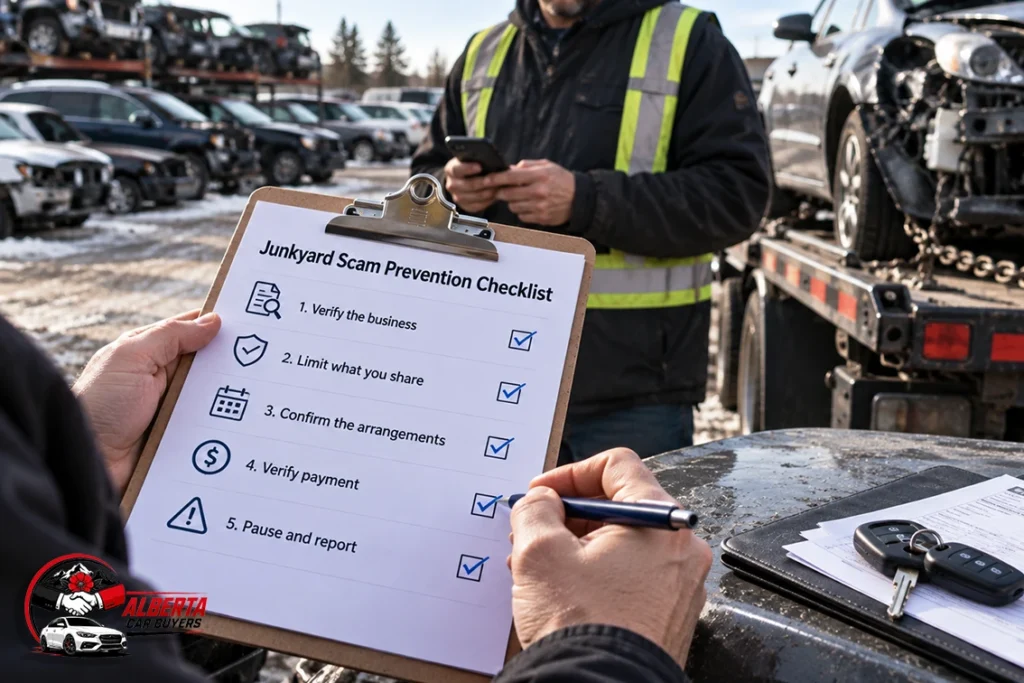
Junkyard Scam Prevention Checklist
Work through these five steps in order during a sale, and stop at any point where something doesn’t add up.
- Before accepting an offer, verify the business. Find its contact details yourself, check licensing where it applies, and get the price, fees, and payment method in writing. A written, verified offer gives you something to compare against if anything changes.
- Before sharing information, limit what you give. Share only what the sale needs, never share banking logins or security codes, and avoid clicking unexpected links or scanning QR codes. Scammers rely on credentials and links to reach your accounts.
- Before pickup, confirm the arrangements. Know who is coming, when, and how you’ll be paid, and keep your documents and records together. Changes at the last minute are a common pressure point.
- Before releasing the vehicle, verify payment. Check the funds in your own account, decline refund requests, and keep the keys and documents until the money is confirmed. Payment that isn’t verified may not exist.
- If something feels suspicious, pause and report. Save the evidence, contact your bank if needed, and use the official reporting channels. Prompt action and clear records help authorities and may limit losses.
How Does Alberta Car Buyers Approach Vehicle Transactions?
Alberta Car Buyers is a direct vehicle-buying service. It isn’t a junkyard, salvage yard, or U-pull-it yard, and it doesn’t sell used parts. Its approach is to buy vehicles directly from owners, which is relevant to this article only as an example of a business a seller can verify before agreeing to anything.
Don’t treat a company’s own claims as independent verification. To confirm Alberta Car Buyers, find its official website through your own search, compare the phone number and email you find with what you were given, and check AMVIC’s database, where its licensing applies, and Service Alberta’s business resources yourself. Its official contact details are (587) 324-2142 and hello@albertacarbuyers.ca.
Before you sell to any buyer, including this one, confirm the quote, fees, pickup arrangements, and payment method in writing. To see what a typical sale looks like from start to finish, read how the Alberta Car Buyers process works.
Common Questions
Want a Straightforward, Scam-Free Car Sale?
If you want to know exactly what your vehicle is worth under current Alberta market conditions, Alberta Car Buyers can give you a firm number quickly. We buy vehicles in any condition across Calgary and 55+ Alberta cities, with free towing and cash paid on pickup. Email hello@albertacarbuyers.ca or get a quote and we’ll get back to you with a real offer, no obligation.
Final Thoughts on Junkyard Scams in Alberta
Most scam prevention comes down to a few habits: verify the business independently, verify payment through your own banking, avoid unexpected links and refund requests, protect sensitive information, and document the transaction. A professional-looking website isn’t proof of legitimacy. If something feels wrong, pause, save the evidence, and use the official reporting channels.
References & Further Reading
- Canadian Anti-Fraud Centre, Protecting yourself online: https://antifraudcentre-centreantifraude.ca/features-vedette/2024/10/protecting-yourself-protegez-vous-eng.htm
- Canadian Anti-Fraud Centre, Merchandise: https://antifraudcentre-centreantifraude.ca/scams-fraudes/merchandise-marchandises-eng.htm
- Canadian Anti-Fraud Centre, Service (resale fraud): https://antifraudcentre.ca/scams-fraudes/service-eng.htm
- Canadian Anti-Fraud Centre, Fraudsters impersonating the Canadian Anti-Fraud Centre: https://antifraudcentre-centreantifraude.ca/news-nouvelles/2024/2024-07-02-eng.htm
- Alberta.ca, Unfair business practices: https://www.alberta.ca/unfair-business-practices
- Alberta.ca, Report a Rip-off: https://www.alberta.ca/report-a-rip-off
- Alberta.ca, Consumer complaints and investigations: https://www.alberta.ca/consumer-protection-complaints
- Alberta.ca, Active consumer alerts: https://www.alberta.ca/consumer-alerts
- Alberta.ca, Scrap metal transactions: https://www.alberta.ca/scrap-metal-transactions
- AMVIC, How to file a complaint: https://www.amvic.org/consumer/complaint-process/
- AMVIC, Alberta Motor Vehicle Industry Council (licensed business database): https://www.amvic.org/