
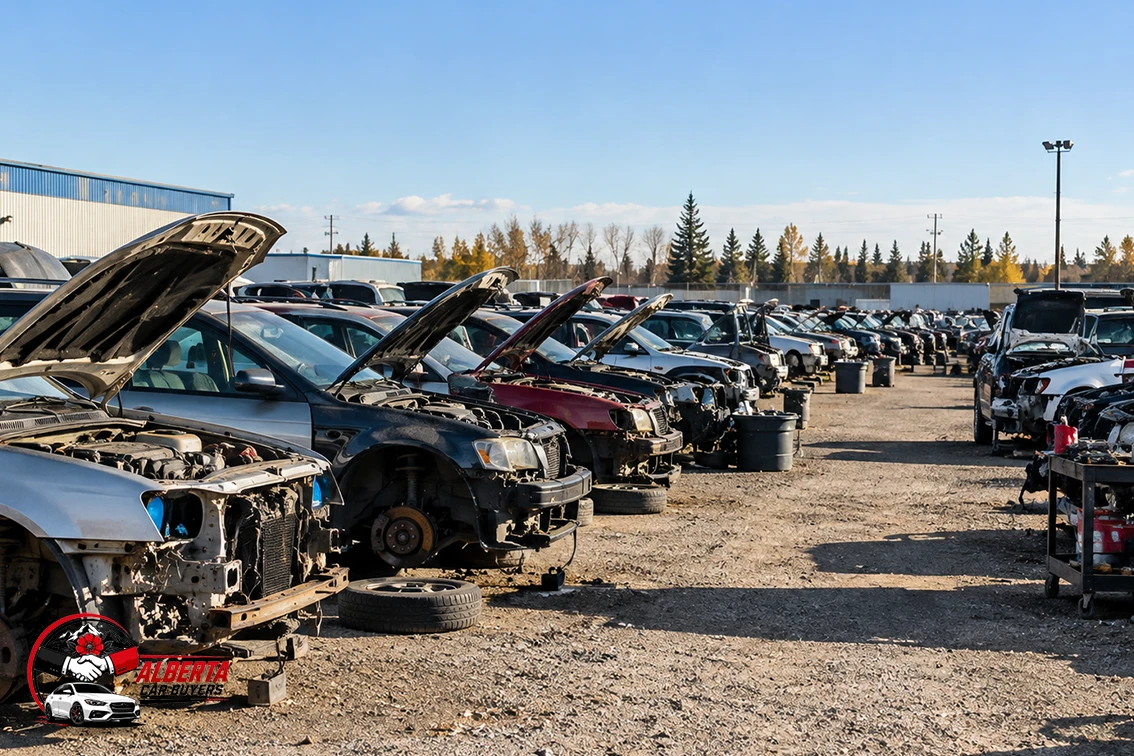
Replacing a part on an older vehicle with a new part can have unreasonable costs, and that’s why many Alberta drivers start by looking for a used one. A self-service junkyard is a yard where customers locate a matching vehicle and remove the part themselves, usually paying per part. Modern operators may call themselves self-service auto parts yards or auto recyclers, but the idea is the same: you do the work and may save money. The trade-off is time, tools, and uncertainty about what’s actually on the lot. This guide explains how self service junkyards in Alberta work, how to find and prepare for a visit, and when a full-service recycler or a direct vehicle buyer fits your goal better.
Ready to Sell Your Junk Car Instead?
If you want to know exactly what your vehicle is worth under current Alberta market conditions, Alberta Car Buyers can give you a firm number quickly. We buy vehicles in any condition across Calgary and 55+ Alberta cities, with free towing and cash paid on pickup. Email hello@albertacarbuyers.ca or get a quote and we’ll get back to you with a real offer, no obligation.

What Is a Self-Service Junkyard in Alberta?
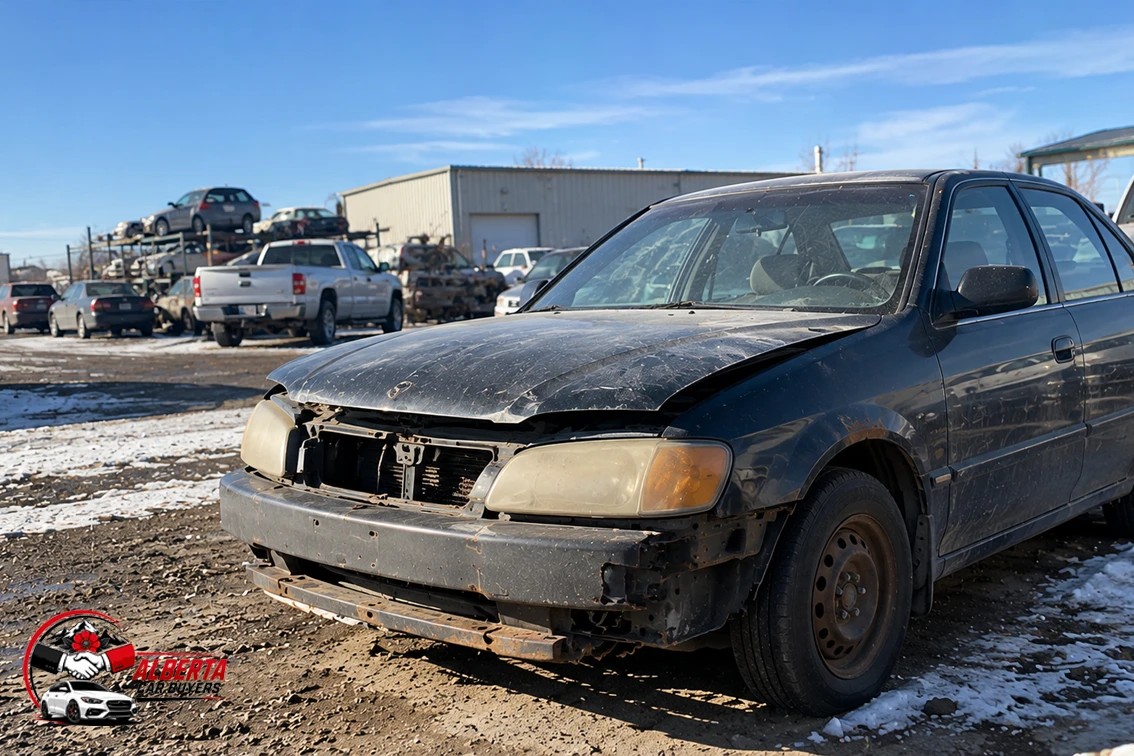
A self-service junkyard is a yard where customers search for vehicles and pull the parts they need with their own tools, then pay under the yard’s pricing system. The same business may call itself a self-service auto parts yard, a pick-and-pull, a U-pull-it, a salvage yard, or an auto recycler, and the names aren’t always interchangeable. A business called a “junkyard” doesn’t necessarily let customers pull their own parts, so the service model has to be verified.
The common terms mean slightly different things:
- Self-service auto parts yard. The customer finds the vehicle and removes the part.
- Pick and pull, or U-pull-it. Informal names for the same customer-removal model.
- Salvage yard. A broader term for a yard holding damaged or retired vehicles, which may or may not allow customer removal.
- Auto recycler. A business that processes end-of-life vehicles, sometimes selling parts, sometimes recycling materials, and sometimes both.
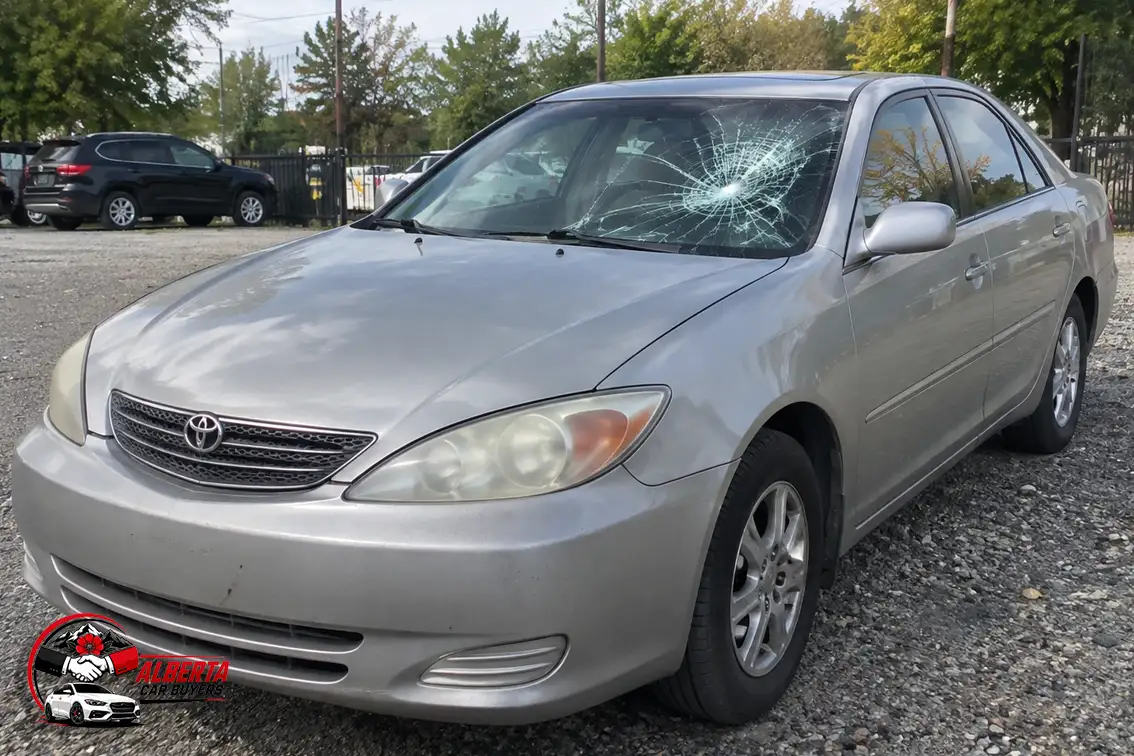
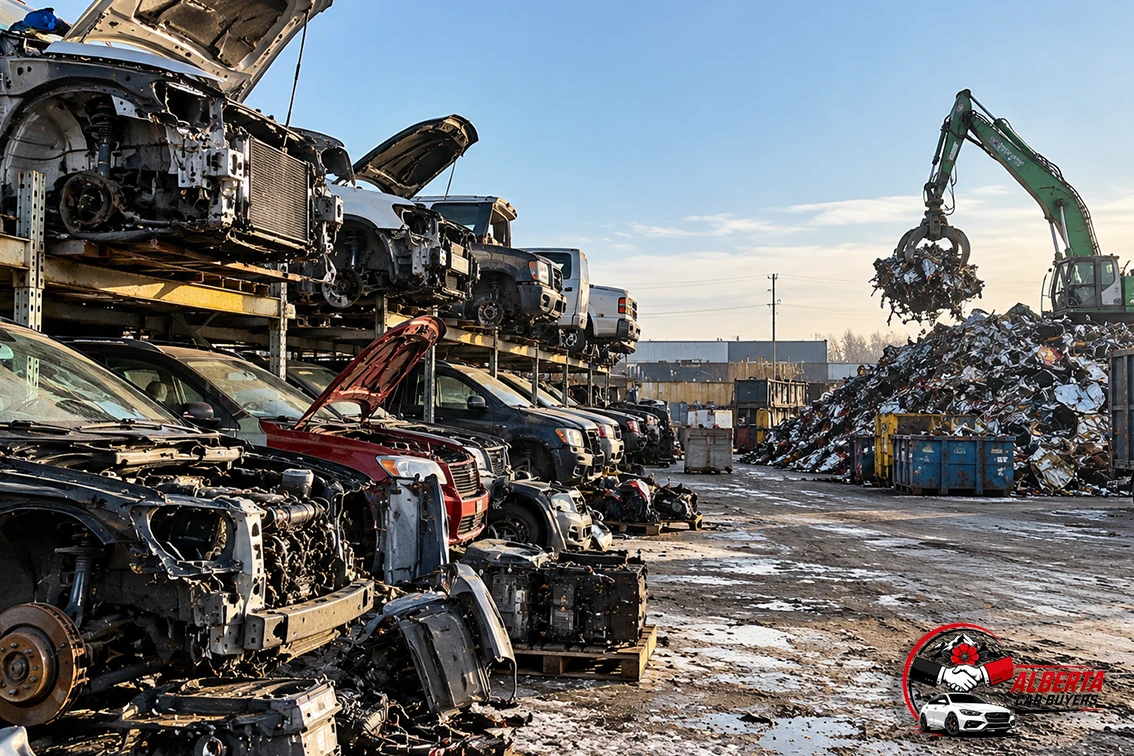
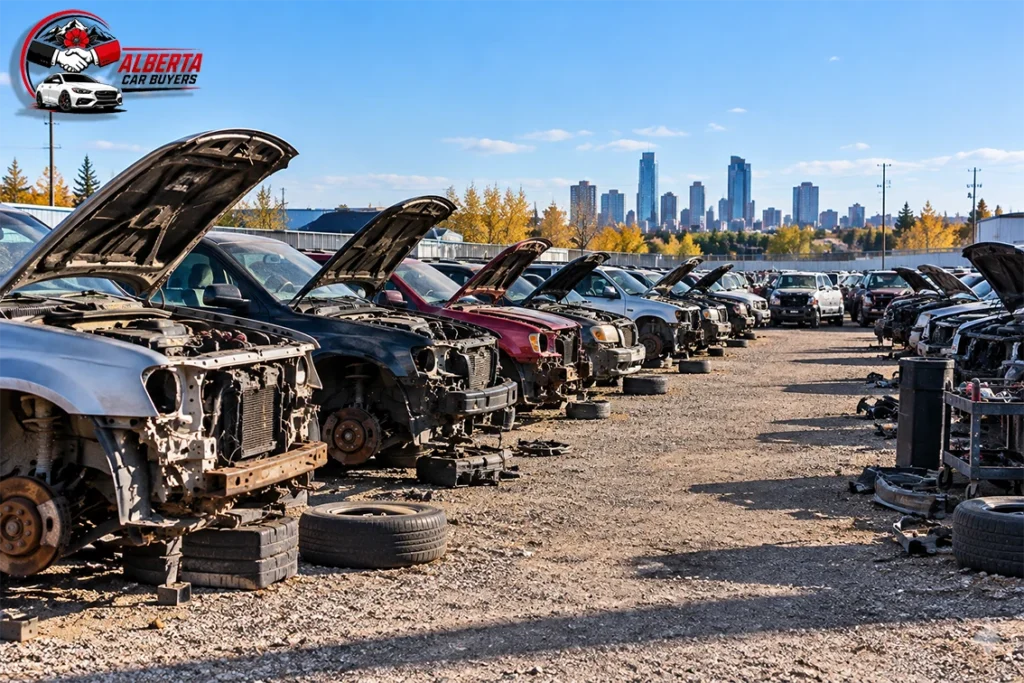
The vehicles customers pull from are often called donor vehicles. They can be older cars that ran fine before, accident-damaged vehicles, or vehicles that can no longer be repaired for the road. Alberta’s Vehicle Inspection Regulation defines a non-repairable vehicle as a salvage vehicle with no resale value except as a source of parts or scrap metal, but that status doesn’t describe every vehicle in a yard. Self-service yards are one stage in end-of-life vehicle recycling, and for the next stage, see what happens to your car after you sell it for cash.
How Do Self-Service Junkyards in Alberta Work?
The typical customer experience follows a pattern, but it isn’t universal, because admission, inventory access, pricing, tools, and removal rules vary by operator. Treat the steps below as a general model and confirm each one with the yard you plan to visit.
- Check inventory. Search online for the vehicle you need, or call the yard.
- Confirm the rules. Ask about admission, tools, payment, and what the yard allows.
- Arrive and sign in. Many yards charge an entry fee or check bags and toolboxes at the gate.
- Locate the vehicle. Yards usually organize vehicles by make or category, and some provide a map or row numbers.
- Remove the part. The customer does this with their own tools, within the yard’s safety rules.
- Pay for the part. Pricing may be a posted price list, a per-part fee, or a formula, and it differs between yards.
After you remove a part, it goes to the counter for payment, and the yard may ask about returns, core charges, or exchange terms. Keep your receipt, because it matters if the part turns out to be wrong.
Where Can You Find Self-Service Junkyards in Alberta?
Self-service yards operate in Edmonton and Calgary. Verify a yard’s current service model, hours, and rules before travelling.
- Edmonton. Some offer online inventory and interchange searches, text alerts when a matching vehicle arrives, and a paid option in which staff pull the part. Some charge an entry fee and expect customers to bring their own tools.
- Calgary. Self-serve yards operate here as well, with customers checking availability online, bringing their tools, and pulling parts themselves. Some also offer an optional paid service in which staff pull certain parts.
Smaller communities may be served by full-service recyclers or auto wreckers, and those businesses sell parts differently. Before you drive anywhere, call and ask whether customers can pull their own parts.
To verify a yard, check the business’s own website for its service model, ask about rules and fees by phone, and look up whether it holds an Alberta automotive business licence. AMVIC, the Alberta Motor Vehicle Industry Council, licenses automotive businesses, and it places dismantling and recycling vehicles for parts under its automotive repair class.
How Do You Check Self-Service Junkyard Inventory Before Visiting?
Inventory changes often, because vehicles arrive, get picked over, and leave, so checking before you travel can save a trip. Online inventory is a useful guide, but it doesn’t promise that a specific part is still on a specific vehicle.
Can you search online? Often yes. Many yards offer online inventory searches by make, model, and location, and some add interchange searches and alerts when a matching vehicle arrives. How current is the list? It varies. A vehicle may be listed even though another customer has already pulled the part you want, so treat the list as a starting point.
Have this information ready before you search:
- the year, make, model, trim, and engine of your vehicle
- the part you need, and its part number if you can find one
- your VIN, if the yard’s search tool uses it
- photos of the old part for comparison
Then call the yard and confirm the vehicle is still there, the yard’s hours and fees, and whether tools are allowed. A short call is cheaper than a wasted trip.
What Should You Bring to a Self-Service Junkyard?
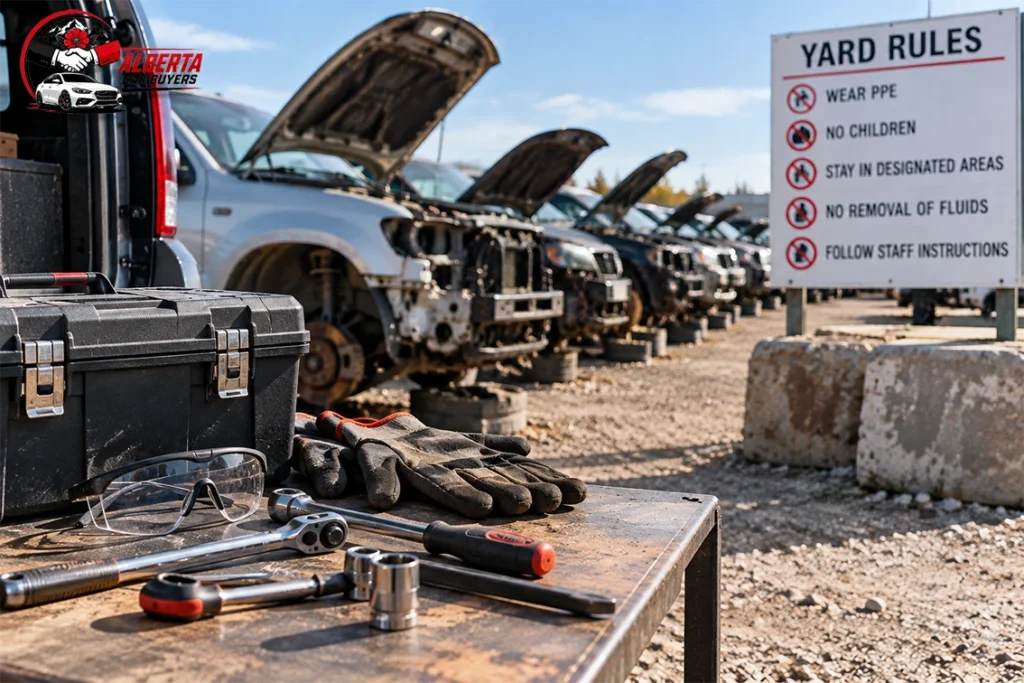
Preparation makes the visit faster and safer, and the yard’s own rules always take priority over a general list. Check what each yard allows before you pack.
Most customers bring:
- Tools. Many yards expect customers to bring their own, and some check bags and toolboxes at the entrance. Confirm which tools are permitted, including whether power tools are allowed.
- Protective equipment. Gloves, sturdy closed-toe footwear, and eye protection are common choices, and the yard may require some of them.
- The old part or part number. Comparing the used part with your original is the best way to confirm a match.
- Weather-appropriate clothing. Yards are outdoors, and an Alberta winter or a hot afternoon changes how long you can comfortably work.
- Payment. Confirm the yard’s accepted payment methods before you go.
Some yards sell basic tools or offer to pull the part for a fee. If you can’t bring tools or lack the time, ask whether full-service removal is available.
How Do You Know Which Used Part Will Fit Your Vehicle?
A part that looks similar isn’t necessarily compatible. Fit can depend on the exact vehicle application, the engine, the trim level, the production date, and the part number, so verify before you pay.
Make, model, and year are the starting point, but two similar vehicles can use different parts. Within a single model year, manufacturers sometimes change components partway through production, and engine or trim differences can change which part fits. A part number from your old part is more reliable than a visual match. Some yards offer interchange information, which lists other vehicles that use the same part, and that can widen your options.
Before paying, compare the used part with your old one side by side. Check the connectors, mounting points, and part number, and ask the yard about its return or exchange policy in case it doesn’t fit.
Are Parts From Self-Service Junkyards Cheaper?
They can be, but there’s no universal saving. Self-service parts may cost less because the customer does the removal work, and a used part often costs less than a new one. The real question is the total cost, including your time, tools, and effort.
Costs and effort to weigh include:
- Entry fees. Some yards charge to enter.
- Tools and gear. You may need to buy or borrow what you don’t own.
- Time. Finding the vehicle and removing the part can take longer than expected.
- Risk of the wrong part. A mismatch can cost another trip or a restocking issue.
- Pricing differences. Some yards price per part, while others use a formula, and policies on cores and exchanges vary.
A full-service used part may be more practical when you don’t have tools, time, or experience, or when the part is complicated to remove. You pay more for the convenience, but you receive a ready-to-install part.
What Are the Rules at a Self-Service Junkyard?
Each yard sets its own rules, and they can differ between locations of the same business. Confirm the details below before you visit, because yard-specific rules matter more than any general guidance.
- Admission. Is there an entry fee, and is there an age limit?
- Guests and pets. Are children, passengers, or pets allowed in the yard?
- Tools and equipment. Which tools are permitted, and are power tools or torches banned?
- Payment. What forms of payment does the yard accept?
- Returns, exchanges, and warranties. Some operators advertise cash-back or exchange periods, while others sell parts as is, so ask what’s covered and for how long.
- Prohibited activities. Ask what you can’t do in the yard, and follow staff directions at all times.
Self-Service vs Full-Service Auto Recycler: What's the Difference?
The key difference is who removes the part and how much work the customer takes on. Neither model is better for everyone, and a direct vehicle buyer serves a different goal altogether. The table compares all three.
| Self-service yard | Full-service recycler | Direct vehicle buyer | |
|---|---|---|---|
| Main purpose | Sells parts you remove yourself | Sells parts that staff remove | Buys an unwanted vehicle |
| Who does the work | The customer | The yard's staff | The buyer collects the vehicle |
| Time and effort | Highest for the customer | Lower, since the part comes ready | Lowest for someone who wants to sell |
| Cost tendencies | May cost less per part, with extra costs for time and tools | May cost more for convenience | Pays the seller based on the vehicle |
| Best for | DIY mechanics comfortable removing parts | Buyers who want a ready part | Owners disposing of a vehicle |
Self-service suits someone who has the tools, the know-how, and the time, which is why self service junkyards in Alberta appeal most to DIY mechanics. Full-service suits someone who wants a specific part without the work. A direct vehicle buyer is for someone who doesn’t need a part at all.
What Should You Know About Safety at a Self-Service Junkyard?
A parts yard isn’t a workshop, and customers shouldn’t assume every vehicle or component is safe to work around. Keep safety practical and follow the yard’s rules.
Follow the yard’s rules. They exist because yards contain heavy vehicles, sharp edges, and uneven ground. Staff instructions and posted signs come first.
Know what can make removal risky. Vehicles may be unstable, damaged, or leaking, and parts may be rusted, heavy, or tightly fastened. Weather can make surfaces slippery or hot.
Avoid these:
- working in a way the yard prohibits
- bringing guests or children where they aren’t allowed
- removing hazardous components or fluids unless the yard explicitly permits it
- rushing, especially with heavy parts
- taking anything you haven’t paid for
If a part looks too difficult or risky to remove, choose full-service removal or a different source.
Can You Sell Your Junk Car to a Self-Service Junkyard?
Sometimes, but not always. Selling a car is different from pulling parts, and a self-service parts business isn’t necessarily a vehicle buyer. Some operators also buy vehicles, for example, and some advertise cash for cars alongside their parts business, while others don’t purchase from the public at all. Always ask directly whether a yard buys complete vehicles, what documents it needs, and what happens to the vehicle.
If your actual goal is to sell the whole vehicle, a direct vehicle buyer may fit better than a parts yard. The value of the entire car depends on factors such as weight, condition, and completeness, which you can read about under scrap car prices in Alberta. Comparing a yard’s offer with a direct buyer’s gives you a clearer picture.
Self-Service Junkyard Visit Checklist
A visit goes more smoothly when you treat it as four stages, from the call before you leave to the receipt in your pocket. The table lays out what to check at each stage and why it matters. Adjust every step to the yard’s own rules, because those take priority over any general list.
| Stage | What to check | Why it matters |
|---|---|---|
| Before you leave | Confirm the vehicle and part are still on the lot, check the hours, fees, and rules, pack the tools and protective gear the yard permits, and bring the old part or its part number | Inventory changes quickly and rules differ by yard, so a short call can prevent a wasted trip or being turned away at the gate |
| When you arrive | Pay any entry fee, sign in as required, follow posted rules and staff instructions, and find the vehicle using the yard map or row numbers | Following the sign-in process and the yard's rules keeps the visit safe and avoids problems with tools or access |
| Before you pay for a part | Compare it with your old part, check its condition and any connected components, and ask about returns, exchanges, and warranty terms | A mismatch or damage is easiest to catch before you pay, and policies vary by operator |
| Before you leave the yard | Keep your receipt, confirm you have everything you paid for, and note the vehicle and row in case you need to go back | A record helps with exchanges and saves time if the part turns out to need a second look |
A few habits make the checklist more useful. Take a photo of how the part is connected before you remove it, so you can refer to it later. Write down the vehicle’s row and the part number on your phone, and keep the receipt somewhere you won’t lose it. If anything doesn’t match what you expected, ask a staff member before you pay, because it’s much easier to sort out at the counter than after you’ve left.
Self-Service Junkyards vs Alberta Car Buyers
The two serve different purposes. Self-service yards are relevant when you want to find and remove used parts, while Alberta Car Buyers is a direct vehicle-buying service for someone who wants to sell an unwanted vehicle. Alberta Car Buyers isn’t a junkyard, salvage yard, or U-pull-it yard, and it doesn’t sell used parts or offer yard access.
What it does instead is buy vehicles directly from owners and process them through licensed Alberta auto recyclers. That makes it relevant when a vehicle is damaged, no longer economical to repair, or simply unwanted, and the owner’s goal is to sell it, not to pull a part. It isn’t presented as better than a self-service yard, since the right choice depends on what you need.
If you have an unwanted car and want an offer, call (587) 324-2142 or email hello@albertacarbuyers.ca with the vehicle’s details. To see the steps from the first call through pickup, read how the Alberta Car Buyers process works.
Common Questions
Ready to Sell Your Junk Car Instead?
If you want to know exactly what your vehicle is worth under current Alberta market conditions, Alberta Car Buyers can give you a firm number quickly. We buy vehicles in any condition across Calgary and 55+ Alberta cities, with free towing and cash paid on pickup. Email hello@albertacarbuyers.ca or get a quote and we’ll get back to you with a real offer, no obligation.
Final Thoughts on Self Service Junkyards in Alberta
Self-service junkyards in Alberta reward preparation. The customer finds and removes the part, so checking inventory, confirming yard rules, and verifying compatibility matter as much as the tools you bring. Doing the work yourself can lower the cost, while a full-service recycler trades some savings for convenience. Shopping for a part is also different from selling an unwanted vehicle, which calls for a direct vehicle buyer.
References & Further Reading
- Alberta King’s Printer, Vehicle Inspection Regulation, Alta Reg 211/2006: https://kings-printer.alberta.ca/documents/Regs/2006_211.pdf
- CanLII, Vehicle Inspection Regulation, Alta Reg 211/2006 (current version): https://canlii.ca/t/8392
- AMVIC, Business licence classes: https://www.amvic.org/business/business-licence/business-license-classes/
- AMVIC, Alberta Motor Vehicle Industry Council (licensed business database): https://www.amvic.org/