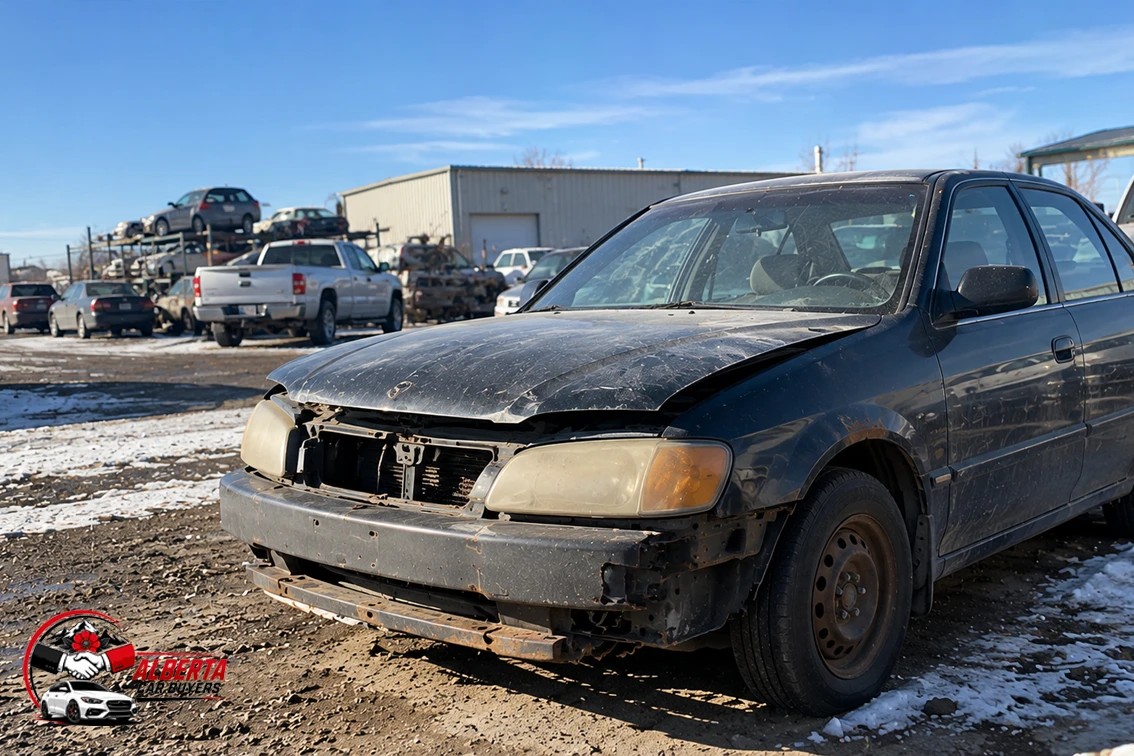

Look for a place to deal with an old car and you’ll meet a pile of overlapping names: junkyard, scrap yard, salvage yard, auto wrecker, auto recycler. So what is the difference between a junkyard and a scrap yard? A junkyard is a broad everyday term for a place associated with old or damaged vehicles and their parts, while a scrap yard generally focuses on buying, processing, and recycling scrap materials, especially metal. The trouble is that businesses don’t always use the words that way, so a name can mislead you about what’s offered. This guide explains the difference between junkyards and scrap yards in Alberta, how the related terms fit in, and how to match the right business to your goal.
Ready to Sell Your Whole Car Instead of Parts?
If you want to know exactly what your vehicle is worth under current Alberta market conditions, Alberta Car Buyers can give you a firm number quickly. We buy vehicles in any condition across Calgary and 55+ Alberta cities, with free towing and cash paid on pickup. Email hello@albertacarbuyers.ca or get a quote and we’ll get back to you with a real offer, no obligation.

What Is the Difference Between a Junkyard and a Scrap Yard?
A junkyard is commonly a broad, informal label for a yard linked to old, damaged, or dismantled vehicles and parts, and a scrap yard usually emphasizes collecting, buying, processing, and recycling scrap material. These are practical descriptions, not rigid legal categories in Alberta, and many businesses use the words interchangeably or combine the activities. So the difference between junkyards and scrap yards matters less than what a given business actually buys, sells, dismantles, or recycles.
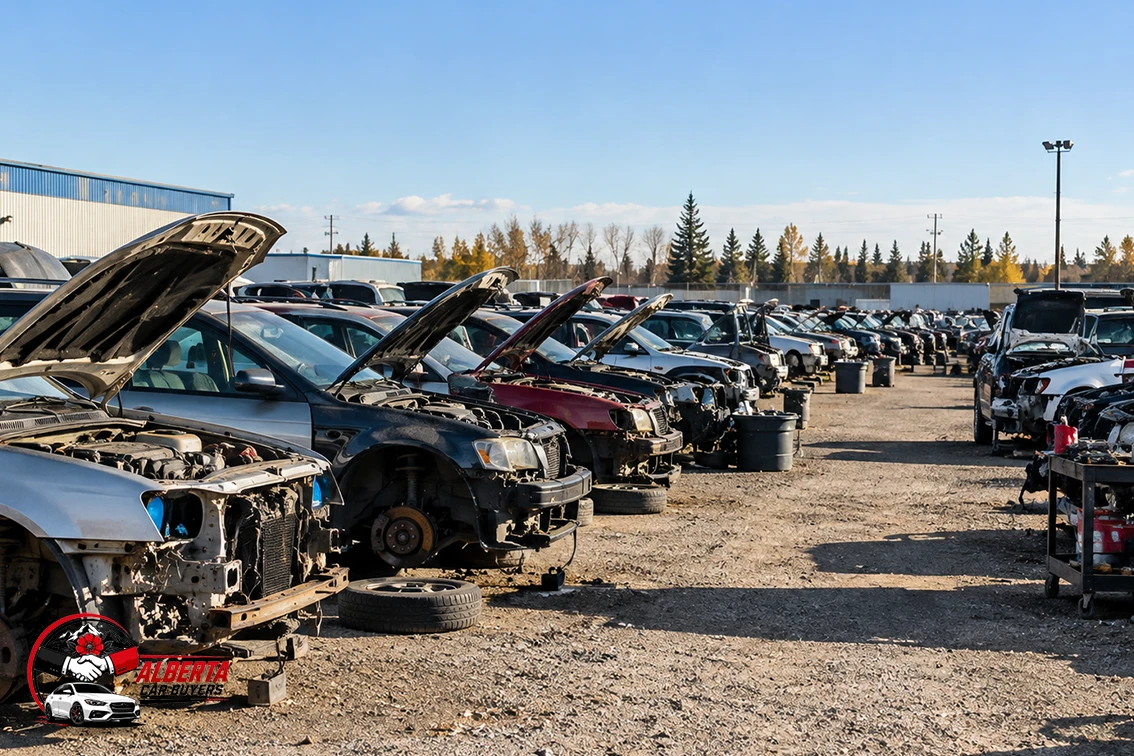
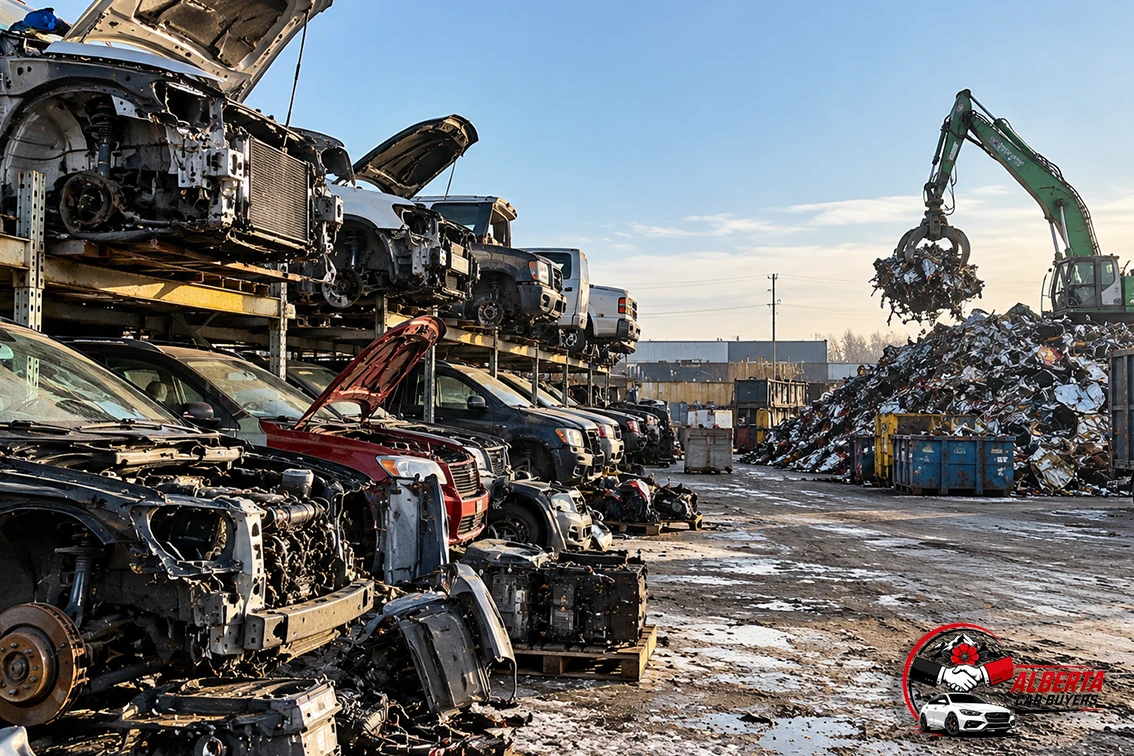
What “junkyard” usually means. It suggests a yard where old vehicles end up, and it may involve selling used parts, dismantling vehicles, recycling what’s left, or simply storing them. Not every junkyard does all of these, and not every one sells parts. The word is also written as two, so a junk yard vs scrap yard Alberta comparison covers the same ground as a junkyard one.
What “scrap yard” usually means. It suggests a business built around metal and other recyclable material, often buying it by weight and processing it for recycling. Some scrap yards accept complete vehicles, while others focus on loose metal.
Can they be the same business? Yes. One operation can sell used parts, dismantle vehicles, and process scrap metal. That overlap is why the difference between junkyard and scrap yard Alberta businesses is better judged by the services they provide than by the name on the sign.
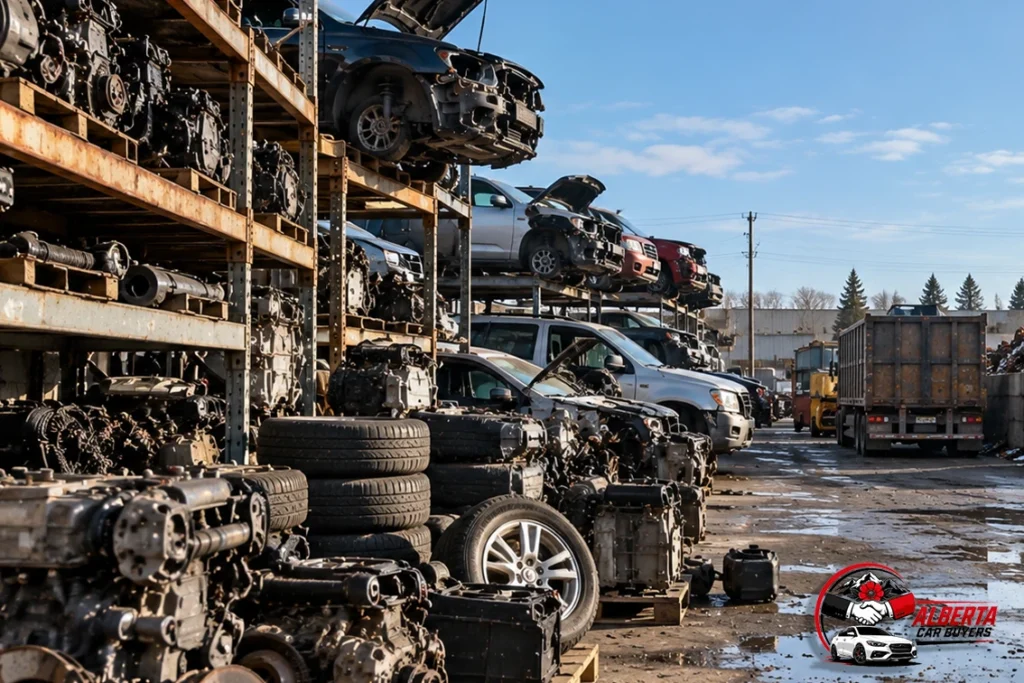
What Does a Junkyard Do With Old Cars?
Services vary by operator, but a business people call a junkyard commonly does some mix of three things with the vehicles it holds:
- Sells used parts. Some junkyards sell usable components from their vehicles, while others don’t sell parts at all.
- Dismantles vehicles. Some take vehicles apart to recover parts and materials, and Alberta’s licensing places vehicle dismantling under the automotive repair class, along with recycling vehicles for parts.
- Recycles what remains. Once usable parts are removed, the remaining materials are typically sent for recycling.
Don’t assume a junkyard does any one of these. Ask before you travel.
What Does a Scrap Yard Do With Cars?
A scrap yard, sometimes called a scrap metal yard, handles vehicles and other metal as raw material, but it doesn’t follow that every scrap yard takes complete cars from the public. Ask three questions: does it buy whole vehicles, what happens to a car once it arrives, and does it accept other kinds of metal?
Do scrap yards buy complete vehicles? Some do, and some focus on loose metal such as pipe, wire, or machinery. Confirm before you arrange a drop-off.
What happens to a car at a scrap yard? Vehicle recycling at a scrap yard usually means the car is processed for its recyclable materials, with the metal separated and sent onward. The details differ by facility.
Can a scrap yard handle other scrap metal? Yes. A scrap-metal dealer or recycler can handle materials other than complete vehicles, which is a major reason its focus differs from a vehicle-focused yard.
Junkyard vs Scrap Yard: What Is the Difference in Services?
Compare services and not labels, because the junkyard vs scrap yard question is really about what each business does. The table summarizes what each type of business typically focuses on, with “varies” used wherever the answer depends on the operator.
| Type | Main focus | Sells used parts | Focuses on scrap metal | Buys complete vehicles | Customer pulls parts |
|---|---|---|---|---|---|
| Junkyard | Broad everyday term for a yard with old or damaged vehicles | Varies | Varies | Varies | Varies |
| Salvage yard or auto wrecker | Recovering usable parts and recycling the rest | Often | As part of the process | Varies | Usually not, unless it's self-service |
| Auto recycler | Reusable parts and recyclable materials from end-of-life vehicles | Often | As part of the process | Varies | Varies |
| Scrap yard | Buying, processing, and recycling scrap materials | Not usually the main focus | Yes | Varies | Not typically |
| Self-service yard | Customers find vehicles and remove their own parts | Yes, through customer removal | Varies | Varies | Yes |
| Direct vehicle buyer | Buying the whole vehicle from the owner | No | Not itself | Yes | No |
One business can fall into several rows at once, and none of these rows is better than another. They answer different needs.
What Is the Difference Between a Junkyard, Salvage Yard, and Auto Recycler?
These three terms overlap even more than junkyard and scrap yard do, and readers often meet them in the same search. They describe business models and not rigid definitions.
- Salvage yard. Commonly a vehicle-focused operation that holds damaged vehicles and recovers usable parts, with the remaining material recycled. Actual services vary.
- Auto wrecker. Often used for a business that dismantles vehicles for parts. It’s close in meaning to salvage yard, and the two are frequently used interchangeably.
- Auto recycler. A label that emphasizes auto recycling: recovering reusable parts and recyclable materials from an end-of-life vehicle (ELV). AMVIC, Alberta’s automotive regulator, places dismantling and recycling vehicles for parts under its automotive repair licence class.
The overlap exists because businesses choose names for marketing as much as for accuracy, so a salvage yard vs junkyard comparison, an auto recycler vs junkyard comparison, or an auto wrecker vs scrap yard comparison should always come back to the services offered. A company might call itself a recycler to stress environmental practices, a salvage yard to stress used parts, or a junkyard because that’s what customers search for.
Is a Self-Service Junkyard the Same as a Scrap Yard?
No. Self-service describes how customers use a yard, not what kind of business it is. In a self-service or pick and pull yard, customers locate donor vehicles and remove parts themselves, usually paying per part, while a full-service business has staff remove the part. A yard can focus on used parts and still be self-service, and a scrap yard isn’t self-service just because it recycles metal. For a closer look at how these yards work in practice, see self service junkyards in Alberta.
Which Business Should You Use for Used Car Parts?
For used auto parts, look first for a business that sells parts: a self-service yard, a full-service salvage yard or auto recycler, or a yard that supplies parts under another name. A self-service yard suits someone with the tools and time to remove the part, while a full-service business suits someone who wants a ready part without the work. Before you buy, confirm the part number fits your vehicle, ask about returns or exchanges, and check the part’s condition. A scrap yard is rarely the right place to look for used car parts, because its focus is material and not components.
Which Business Should You Use to Sell Scrap Metal?
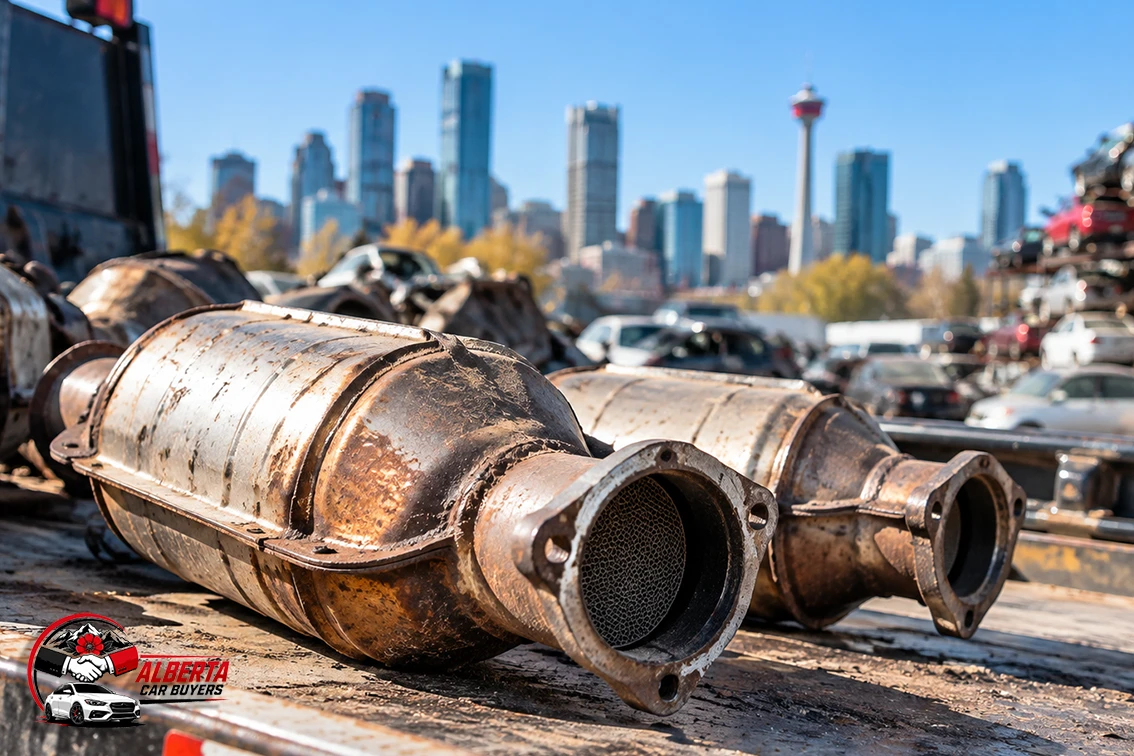
For loose metal or recyclable material, a scrap metal dealer or recycler is the relevant business, and where to sell scrap metal Alberta buyers will accept depends on the material. A vehicle contains several materials that can be treated as scrap, including steel, aluminum, copper wiring, a lead-acid battery, and a catalytic converter. Alberta regulates some of these differently from ordinary parts sales, and the section on Alberta’s scrap-metal rules below explains how. If your goal is to get rid of an entire vehicle, selling pieces of it to different buyers is rarely practical, and it can leave you with a stripped shell that few businesses want. Describing the vehicle as it is, with all its components, keeps your options open.
Which Business Should You Contact to Sell an Entire Vehicle?
Selling a complete unwanted vehicle is a different goal from selling scrap metal or parts. Where to sell a junk car in Alberta, or where to sell an old car for scrap, comes down to who buys complete vehicles. Some junkyards and scrap yards do, and some don’t. A salvage yard, auto recycler, or direct vehicle buyer may also purchase complete vehicles, so the label alone won’t tell you.
Vehicle status can affect the choice. A salvage vehicle can sometimes be repaired and inspected for the road, but Alberta.ca says a vehicle designated non-repairable cannot be re-registered and can only be sold as scrap or dismantled for parts, which narrows the buyers that make sense for it. Not every vehicle in a yard is non-repairable, and not every unwanted car is. For how scrap and salvage status differ, see scrap car vs salvage car in Alberta.
If you want to sell the whole vehicle, a direct vehicle buyer is one alternative to a parts-focused or metal-focused operation. It buys the car from you and may send it on to an auto recycler.
What Are the Alberta Rules for Scrap-Metal Transactions?
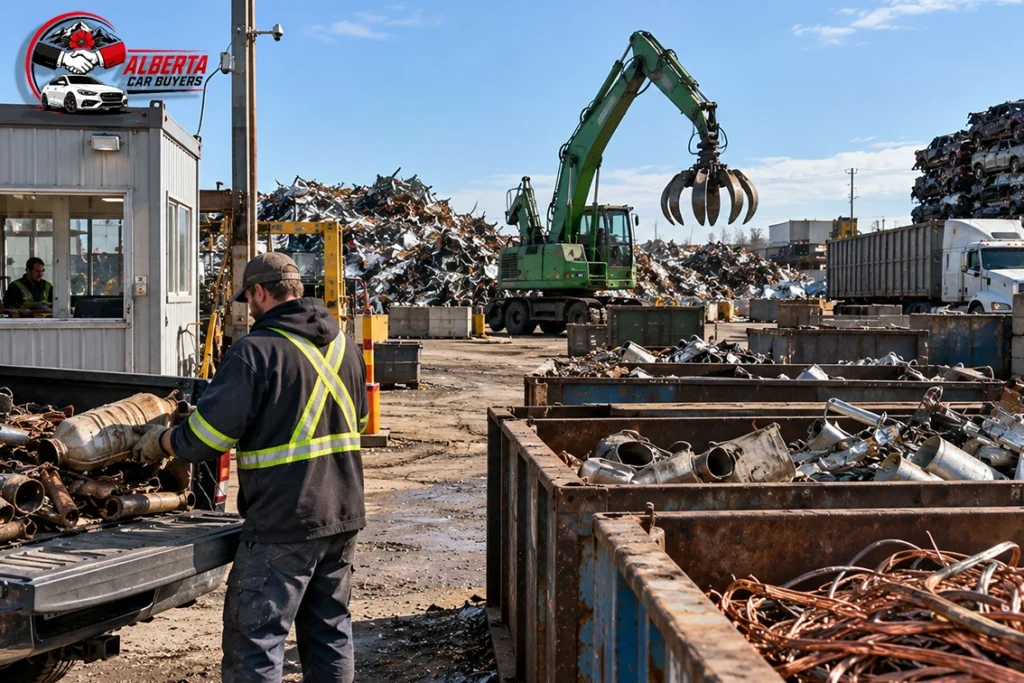
Alberta regulates scrap-metal dealers and recyclers separately from ordinary used-parts sales, and the rules attach to the material being sold, not to every vehicle sale. Alberta.ca explains that since September 1, 2025, all scrap-metal dealers and recyclers must report transactions involving scrap metal to law enforcement through a centralized database, whether they buy from an individual or a business.
What Alberta counts as scrap metal. The Scrap Metal Dealers and Recyclers Identification Act defines scrap metal broadly as new or used items substantially made of non-ferrous metal, including aluminum, brass, bronze, copper, and tin, plus other materials prescribed by regulation. The Scrap Metal Dealers and Recyclers Regulation then lists specific items, including copper cables and wires, metal traffic control lights and signs, street lighting poles and fixtures, sewer grates and manhole covers, guard rails and handrails, metal grave markers and memorial plaques, catalytic converters, and lead-acid batteries. A complete vehicle isn’t one of the specifically listed items, but it contains both ferrous and non-ferrous materials, so whether the requirements apply depends on the material being sold and the nature of the transaction.
What buyers must record. Buyers must record and report the transaction details, including a traceable method of payment (no cash), the seller’s name, address, and government-issued photo identification, and a description of the metal. Catalytic converter transactions require the VIN and/or proof of ownership to be recorded and reported.
Why it can differ from a parts sale. A used-parts sale involves selling a component for reuse, while a scrap-metal transaction involves selling material for recycling, and the reporting rules attach to the second. How the rules apply to a particular sale depends on the items and the transaction, so ask the buyer how they handle it.
Junkyard vs Scrap Yard: Which One Is Right for You?
Whether you end up at a junkyard or scrap yard depends on your goal and not the name. In the junkyard vs scrap yard Alberta decision, no type is better than another, and each answers a different need.
- If you need a used car part, look for a business that sells parts, such as a salvage yard, auto recycler, or self-service yard, and confirm it has your part.
- If you want to pull the part yourself, look for a self-service or pick-and-pull yard, and verify its rules, tools, and fees first.
- If you want to recycle vehicle scrap or loose metal, look for a scrap-metal dealer or recycler, and ask what it accepts and what it records.
- If you want to sell the entire vehicle, look for a business that buys complete vehicles, which may be a junkyard, scrap yard, recycler, or direct vehicle buyer.
How to Identify What a Business Actually Offers
Because the terminology overlaps, a business’s listed services are more useful than its label. Before you drive to a scrap yard or junkyard, or sign anything, ask these four questions:
- Does it buy complete vehicles? If so, ask what documents it needs and how pickup and payment work.
- Does it sell used parts? If so, ask whether your part is available and what the return terms are.
- Does it offer self-service access? If so, ask about tools, fees, and yard rules before you go.
- Does it accept scrap metal? If so, ask what it takes and what it records, because Alberta’s reporting rules apply to certain materials.
Check its own website or call, and write down the answers. A business that answers clearly is easier to deal with than one that relies on a label.
Junkyards, Scrap Yards, and Alberta Car Buyers
Alberta Car Buyers is a direct vehicle-buying service. It isn’t a junkyard, scrap yard, self-service junkyard, or used-parts seller, and it doesn’t operate a U-pull-it yard. It buys vehicles directly from owners.
That makes it relevant for one goal only: selling an entire unwanted vehicle. If you need a part or want to sell loose scrap metal, a parts yard or scrap-metal business fits better. If your goal is to sell the whole car, call (587) 324-2142 or email hello@albertacarbuyers.ca with the vehicle’s details, and read how the Alberta Car Buyers process works to see the steps.
Key Questions Answered
Ready to Sell Your Whole Car Instead of Parts?
If you want to know exactly what your vehicle is worth under current Alberta market conditions, Alberta Car Buyers can give you a firm number quickly. We buy vehicles in any condition across Calgary and 55+ Alberta cities, with free towing and cash paid on pickup. Email hello@albertacarbuyers.ca or get a quote and we’ll get back to you with a real offer, no obligation.
Final Thoughts on Junkyards vs Scrap Yards in Alberta
The labels junkyard, scrap yard, salvage yard, and auto recycler overlap, so the name on the sign matters less than the service behind it. Look for what a business actually does: sells parts, lets you pull them, dismantles and recycles vehicles, processes scrap metal, or buys whole vehicles. Match that service to your goal before you travel, call, or sign anything.
References & Further Reading
- Alberta.ca, Scrap metal transactions: https://www.alberta.ca/scrap-metal-transactions
- Alberta King’s Printer, Scrap Metal Dealers and Recyclers Identification Act: https://kings-printer.alberta.ca/documents/Acts/S03p5.pdf
- Alberta Open Government, Scrap Metal Dealers and Recyclers Regulation: https://open.alberta.ca/publications/2020_124
- Alberta.ca, Buying a used vehicle in Alberta: https://www.alberta.ca/buying-a-used-vehicle-in-alberta
- AMVIC, Business licence classes: https://www.amvic.org/business/business-licence/business-license-classes/