
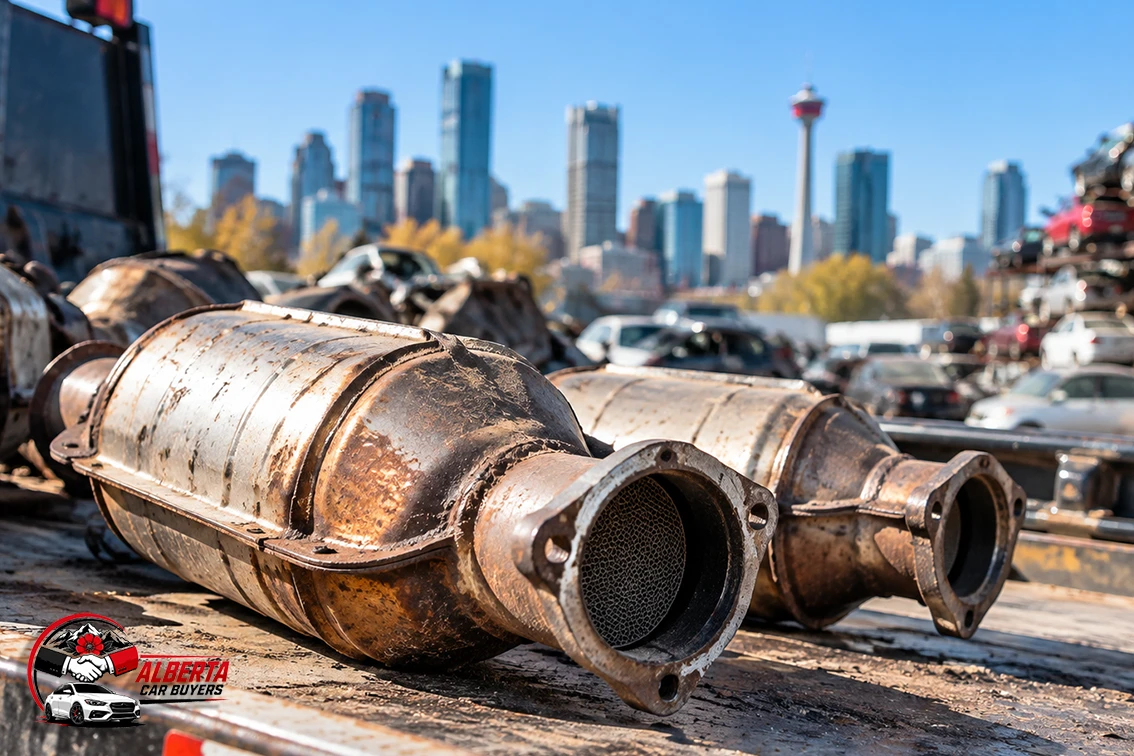
A catalytic converter looks like an ordinary length of exhaust pipe, yet it can hold more recoverable value than the steel around it. Inside, a coated core carries platinum-group metals that recyclers can separate and reuse, and that’s what drives catalytic converter scrap value. No single number applies to every unit, because two converters that look alike can contain very different amounts of metal. What a recycler will pay depends on the specific converter, the vehicle it came from, its condition, how it’s identified, and where precious-metal markets stand that week. This article explains each of those factors in plain terms, using dated market data and Alberta rules, so a seller can read a quote with confidence and know what to ask.
Ready to Get a Quote on Your Scrap Car?
If you want to know exactly what your vehicle is worth under current Alberta market conditions, Alberta Car Buyers can give you a firm number quickly. We buy vehicles in any condition across Calgary and 55+ Alberta cities, with free towing and cash paid on pickup. Email hello@albertacarbuyers.ca or get a quote and we’ll get back to you with a real offer, no obligation.

How Much Is a Catalytic Converter Worth in Scrap?
A catalytic converter’s scrap value varies substantially, and the honest answer is that it depends on the exact converter and on current market conditions. The main drivers are the metal content of the catalyst, the vehicle application the converter was built for, its physical condition, how reliably it can be identified, and the day’s platinum-group metal prices. A buyer’s refining relationships and operating costs shape the final offer as well. That’s why a fair price for catalytic converter scrap value in Alberta can’t be read off a single chart.
The metals inside have published market prices that provide useful context, although rhodium trades mainly through an over-the-counter dealer market and not on a major exchange. This snapshot shows the prices displayed on Kitco’s live chart pages on September 29, 2026, at the times listed. It describes the metals, not what any converter would earn, because one converter holds only a small amount of each.
| Metal | Spot price (USD per troy ounce) | Date and time | Source |
|---|---|---|---|
| Platinum | $1,702.00 | Sept. 29, 2026 | Kitco |
| Palladium | $1,203.00 | Sept. 29, 2026 | Kitco |
| Rhodium | $8,400.00 (bid) | Sept. 29, 2026 | Kitco |
Is There a Standard Catalytic Converter Scrap Price?
No. A single universal price would ignore the things that separate one unit from the next: how much catalyst material it carries, which vehicle it fits, whether it’s intact, and whether the buyer can confirm what it is. Prices for the metals themselves also move daily, and rhodium shows how far. Umicore’s published rhodium price ranged from $8,950 to $9,850 per troy ounce across the September 2026 trading days through the 28th. Any figure quoted without a date, a converter identification, and a buyer behind it should be treated as a rough estimate.
Why Do Catalytic Converters Have Scrap Value?
Catalytic converters are valuable because the catalyst inside them contains platinum-group metals (PGMs), which are scarce and can be recovered through specialized recycling. Natural Resources Canada notes that the most important use of PGMs is in catalytic converters, which sit in the exhaust systems of internal combustion vehicles. NRCan also reports that recycling supplied 26 percent of global PGM supply in 2024, with autocatalyst scrap making up 22 percent. In other words, old converters are a major source of these metals, and that’s the reason recyclers want them.
Once a vehicle has been sold, its metals and parts move through recovery channels. For an overview of that journey, see what happens to your car after you sell it for cash.
What Precious Metals Are Inside a Catalytic Converter?
Three precious metals account for most of a converter’s recoverable value, and each plays a role in cleaning exhaust gases:
- Platinum. A durable catalyst metal that helps convert harmful exhaust gases into less harmful ones.
- Palladium. Widely used in gasoline-engine converters, and often a major contributor to value.
- Rhodium. Present in smaller amounts than the other two, yet valued highly because it’s so scarce.
Their relative contribution changes from one converter to the next. Recyclers note that the composition of spent converters varies significantly with the manufacturer, the catalyst design, and how the unit was used over its life. So a converter isn’t valued by size or weight alone, and any universal gram figure would be misleading. The metals sit on a coated ceramic or metallic core, and they’re recovered from that core, not from the outer shell.
What Determines Catalytic Converter Scrap Value?
Six factors work together, and none of them decides the price alone. The table sets out how each one matters and what a seller should know about it.
| Factor | Why it matters | What the seller should know |
|---|---|---|
| Converter type and design | Different designs carry different amounts of catalyst | Two units that look similar can hold very different metal content |
| Vehicle application | Make, model, engine, and year point to the expected converter | Have the vehicle details ready, because buyers use them to identify the unit |
| Condition | Intact catalyst material is what recyclers recover | Damage, crushing, or missing material lowers what's recoverable |
| Identification | Stamped numbers help match a unit to known applications | Numbers can wear away, so photos and vehicle details help too |
| Metal prices | PGM prices affect what recycling can return to a buyer | Quotes are time-sensitive and can change quickly |
| Buyer and refining process | Buyers differ in sorting methods, costs, and market access | Comparing quotes shows the range |
Does Make, Model, and Year Affect Catalytic Converter Value?
Yes, but as a clue and not a rule. A vehicle’s emissions requirements, engine, and model year shape the converter designed for it, so vehicle details help a buyer estimate the expected catalyst content. That doesn’t mean one brand or model always carries a higher-value converter, and sellers should be wary of any claim that says it does. Identification, condition, and the metal content of the actual unit still decide the result.
Hybrid and specialty vehicles use converters built for their own applications. Their values can be higher or lower than those of conventional vehicles, so it’s best to treat them individually and not assume a pattern.
OEM vs Aftermarket Catalytic Converters: Which Is Worth More?
OEM converters usually have higher scrap value than aftermarket ones, but the label alone doesn’t settle it. An OEM converter is the type fitted at the factory or built to match the original application. An aftermarket converter is made by a third party to replace it. Industry recyclers report that aftermarket units typically carry much lower PGM concentrations and therefore lower scrap value, which is why identifying them correctly matters. OEM units often carry manufacturer, serial, or part-number markings on the shell, though the exact markings vary by manufacturer, and aftermarket markings differ again.
So does OEM always mean higher scrap value? Not necessarily. A buyer still has to confirm what the unit is, what it contains, and what condition it’s in. A worn, damaged, or unidentifiable OEM converter can be harder to price than a clearly marked unit of any kind.
Does Condition Affect the Value of a Scrap Catalytic Converter?
Condition is one of the biggest influences on catalytic converter value, because recyclers are paying for the catalyst material that remains inside. An intact unit may retain recoverable metal that a damaged or emptied unit doesn’t, so a converter that’s whole, identifiable, and undamaged is easier to assess and usually easier to price.
Does a Gutted or Damaged Catalytic Converter Have Scrap Value?
Usually much less. A converter that has been hollowed out or that has lost its catalyst material has little of what a recycler wants, though the outer shell still counts as metal. Crushing or other damage can hide identifying marks and make it harder to judge what’s inside, and buyers often price that uncertainty conservatively. Sellers shouldn’t alter or open a converter to see what’s there. A description and photographs of the unit as it is give a buyer what they need for an honest assessment.
Why Do Catalytic Converter Scrap Prices Change?
Prices change because two things move independently: the metal markets and the buyer’s own circumstances. Platinum, palladium, and rhodium trade on markets that shift daily, and recyclers recover value from those metals, so a rise or fall in the metals feeds into what buyers can offer. The rhodium range noted above shows how quickly that can happen.
Buyers also differ from one another. Some identify converters carefully from serial numbers and photographs, while others price more broadly. Recyclers typically send converters to specialized refiners, where units are graded and processed, so a buyer’s refining relationships, operating costs, market access, and appetite for risk all affect the offer. Two honest buyers can quote different amounts for the same unit on the same day.
How Is a Catalytic Converter Identified for Scrap Pricing?
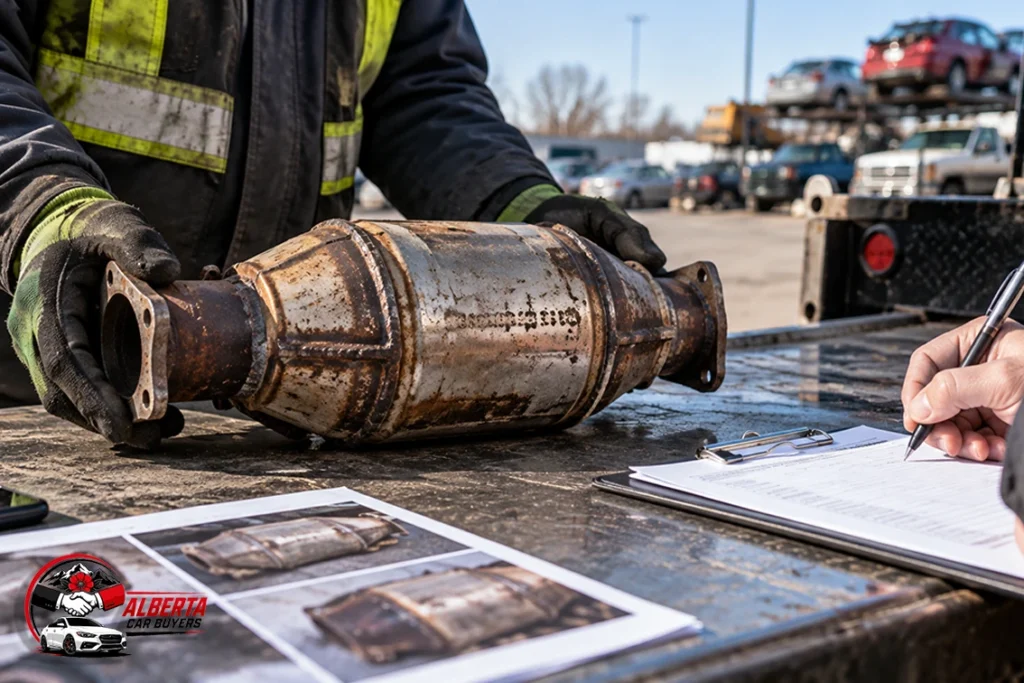
Buyers identify a scrap catalytic converter from several clues that, taken together, point to the expected metal content. A stamped serial or part number is the most direct clue, because it can be matched to known applications. Vehicle year, make, model, and engine narrow the possibilities, and clear photographs show the unit’s condition and any visible markings.
Numbers aren’t foolproof. Recyclers point out that lookup databases rely on a single analyzed sample from one converter, and that rust and corrosion often erase serial numbers on used units. That’s why a good buyer combines the number with vehicle details and photographs instead of relying on one source.
Should You Remove or Open a Converter to Find Its Value?
No. A seller shouldn’t need to remove, cut, or open a converter to get a quote, and doing so can damage the unit and reduce what a buyer can recover. A legitimate buyer works from the vehicle details, any visible identifiers, and photographs of the converter as it sits. If a buyer asks you to take something apart before they’ll give a price, that’s a reason to get a second opinion from another buyer.
Does a Catalytic Converter Increase Scrap Car Value in Alberta?
A converter is one of several components that shape a scrap-car offer, and a vehicle that still has its catalytic converter usually has more recoverable value than one that doesn’t. The reason is simple: recoverable catalyst material adds to the metal and parts value already in the vehicle. That doesn’t make the vehicle’s value equal to the converter’s value plus the steel, because a buyer prices the whole vehicle with its own costs and margins.
The converter also isn’t the only factor. Body metal, weight, usable parts, the vehicle’s overall condition, and the buyer’s recycling economics all contribute. For the broader picture of how those pieces combine, see the breakdown of scrap car prices in Alberta.
What Is a Car's Scrap Value Without Its Catalytic Converter?
A missing catalytic converter usually lowers the vehicle’s scrap value, because the catalyst material that would have been recovered is no longer part of the vehicle. The size of the reduction depends on the vehicle and the converter that should have been there, so there’s no fixed deduction to expect. The best approach is to state plainly that the converter is missing when you ask for a quote. A quote based on the vehicle as it is will hold up at pickup, while a quote based on an assumption that it’s present may not.
How Can You Get a Fair Catalytic Converter Value in Alberta?
A fair value comes from giving buyers good information and comparing what they say. Getting a catalytic converter scrap value Alberta buyers will stand behind takes a little preparation, and three steps make the process easier.
- Provide the details a buyer needs. Share the vehicle’s year, make, model, and engine, any visible converter numbers, its visible condition, and clear photographs.
- Compare more than one quote. Buyers differ in methods and market access, so a second quote shows where the range sits.
- Ask what the quote covers. Confirm whether it’s for a loose converter or for the complete vehicle, and whether it depends on identification or condition checks after the buyer sees the unit.
Alberta adds a documentation layer. Alberta.ca says catalytic converters are defined as scrap metal under the province’s scrap metal rules, and that transactions for them require the buyer to record the vehicle identification number and/or proof of ownership. The same rules require a traceable payment method, with no cash, for covered transactions. A buyer who asks for your ID and ownership details is following the law, and a buyer who skips those steps is a reason for caution.
Catalytic Converter Scrap Value With Alberta Car Buyers
Alberta Car Buyers serves communities across Alberta and buys vehicles in any condition. Its quotes are for complete vehicles, and this article doesn’t describe a separate purchase of loose converters. The catalytic converter is one component considered as part of the vehicle’s overall value.
How Does Alberta Car Buyers Evaluate Catalytic Converter Value?
Alberta Car Buyers looks at a vehicle as a whole, including its weight, condition, components, and whether a catalytic converter is present. It doesn’t promise a fixed price for a converter, since the value depends on the factors covered above and on market conditions at the time of the quote. If the converter is missing or damaged, tell them when you request a quote so the offer reflects the vehicle as it is.
How Can Alberta Sellers Request a Scrap Car Quote?
Call (587) 324-2142 or email hello@albertacarbuyers.ca with the vehicle’s year, make, model, and condition, plus photographs if you have them. Mention whether the vehicle runs and whether the converter is present, because both affect the offer and how pickup is arranged. You’ll receive a free offer with no pressure to accept, and if you agree, you can schedule pickup. The full cash-for-car process is described from the first call through pickup.
FAQs
Ready to Get a Quote on Your Scrap Car?
If you want to know exactly what your vehicle is worth under current Alberta market conditions, Alberta Car Buyers can give you a firm number quickly. We buy vehicles in any condition across Calgary and 55+ Alberta cities, with free towing and cash paid on pickup. Email hello@albertacarbuyers.ca or get a quote and we’ll get back to you with a real offer, no obligation.
Final Thoughts on Catalytic Converter Scrap Value
Catalytic converter scrap value depends on metal content, identification, vehicle application, condition, and current market conditions, so no single number fits every unit. Sellers get the most reliable results by describing the vehicle and converter accurately, comparing more than one quote, and treating any price as a dated estimate. A converter also adds to a scrap car’s value without determining all of it.
References & Further Reading
- Natural Resources Canada, Platinum facts: https://natural-resources.canada.ca/minerals-mining/mining-data-statistics-analysis/minerals-metals-facts/platinum-facts
- Alberta.ca, Scrap metal transactions: https://www.alberta.ca/scrap-metal-transactions
- Kitco, Platinum price: https://www.kitco.com/charts/platinum
- Kitco, Palladium price: https://www.kitco.com/charts/palladium
- Kitco, Rhodium price: https://www.kitco.com/charts/rhodium
- Umicore Precious Metals Management, Rhodium price: https://pmm.umicore.com/en/prices/rhodium/
- PMR, Serial number vs. price lists to identify catalytic converter scrap value: https://pmrcc.com/en/news-blog/catalytic-converter-price/how-to-determine-catalytic-converter-scrap-value/
- PMR, Why are catalytic converters so valuable and how much are they worth: https://pmrcc.com/en/news-blog/catalytic-converter-101/catalytic-converter-value/
- IBC Advanced Technologies, Catalytic converter recycling for recovery of platinum: https://ibcmrt.com/catalytic-converter-recycling-highly-efficient-recovery-of-platinum-palladium-and-rhodium-with-molecular-recognition-technology-mrt/